
Join Our JEE Preparation Group
Prep with like-minded aspirants; Get access to free daily tests and study material.
Sign in
Please select an account to continue using cracku.in
↓ →
Join Our JEE Preparation Group
Prep with like-minded aspirants; Get access to free daily tests and study material.
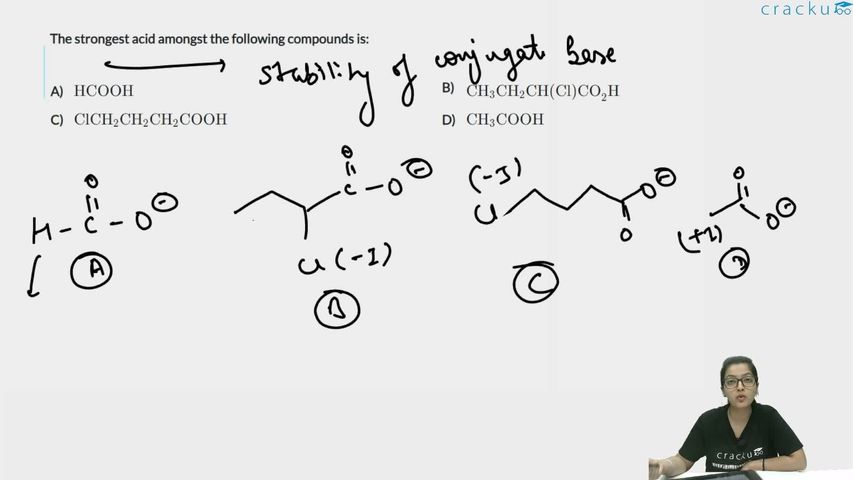
For carboxylic acids, acidity is governed mainly by the stability of the conjugate base $$RCOO^-$$.
The more the negative charge on oxygen is dispersed (stabilised), the stronger the parent acid is.
Electron-withdrawing groups (-I effect) stabilise the conjugate base, while electron-releasing alkyl groups ( +I effect) destabilise it. The -I effect dies out rapidly with distance, so a substituent placed α (one carbon) to the -COOH group has a far larger impact than if it is β or γ.
Let us inspect each option.
Option A $$HCOOH$$ (formic acid)
No alkyl group, hence no +I destabilisation. pKa ≈ 3.75.
Option B $$CH_3CH_2CH(Cl)CO_2H$$ (α-chlorobutyric acid)
Chlorine, an electronegative atom, sits on the α-carbon. Its strong -I effect greatly stabilises $$CH_3CH_2CH(Cl)COO^-$$. Although two CH2 groups are present, their +I effect is weaker and is farther away than the α-chlorine. Net result: highest stabilisation and pKa ≈ 2.8.
Option C $$ClCH_2CH_2CH_2COOH$$ (γ-chlorobutyric acid)
Here chlorine is three carbons away (γ-position). Its -I effect is attenuated by distance, while three CH2 groups contribute considerable +I destabilisation. Hence it is less acidic than formic acid. pKa ≈ 4.5.
Option D $$CH_3COOH$$ (acetic acid)
A single CH3 group exerts a +I effect, giving the least stable conjugate base of the four. pKa ≈ 4.76.
Ordering the acids from strongest to weakest:
$$\text{α-chlorobutyric acid (B)} \; \gt \; \text{formic acid (A)} \; \gt \; \text{γ-chlorobutyric acid (C)} \; \gt \; \text{acetic acid (D)}$$
Therefore, the strongest acid is Option B which is: $$CH_3CH_2CH(Cl)CO_2H$$.
Was this solution helpful?
Click on the Email ☝️ to Watch the Video Solution
Create a FREE account and get:
_1.webp)

Educational materials for JEE preparation

Ask our AI anything

AI can make mistakes. Please verify important information.
AI can make mistakes. Please verify important information.


