
Join Our JEE Preparation Group
Prep with like-minded aspirants; Get access to free daily tests and study material.
Sign in
Please select an account to continue using cracku.in
↓ →
Join Our JEE Preparation Group
Prep with like-minded aspirants; Get access to free daily tests and study material.
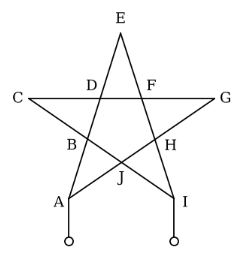
15 equal resistances (AB, BC, CD, ...) are connected to form a star as shown. When the resistances JB and JH are removed the equivalent resistance between terminals A and I is $$R$$. The equivalent resistance between A and I when the resistances AJ and JI are removed would be ____________.
Correct Answer: 2.25
Let each resistance be $$r$$; the star has 5 lines of 3 resistors each (A-B-D-E, E-F-H-I, I-J-B-C, C-D-F-G, G-H-J-A). With JB and JH removed, solving the network by Kirchhoff's laws (using the symmetry about the axis through E and J) gives $$R_{AI} = \frac{4r}{3}$$, so $$r = \frac{3R}{4}$$. With AJ and JI removed instead, the same method gives $$R_{AI} = 3r$$. Hence the new resistance is $$3 \times \frac{3R}{4} = \frac{9R}{4} = 2.25R$$.
Was this solution helpful?


Predict your JEE Main percentile, rank & performance in seconds

Educational materials for JEE preparation

Ask our AI anything

AI can make mistakes. Please verify important information.
AI can make mistakes. Please verify important information.