
Join Our JEE Preparation Group
Prep with like-minded aspirants; Get access to free daily tests and study material.
Sign in
Please select an account to continue using cracku.in
↓ →
Join Our JEE Preparation Group
Prep with like-minded aspirants; Get access to free daily tests and study material.
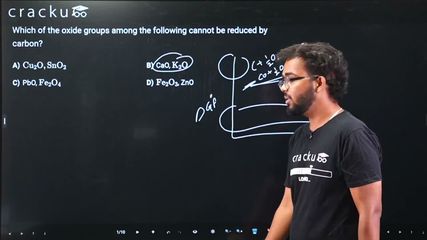
Which of the oxide groups among the following cannot be reduced by carbon?
The reducibility of a metal oxide with carbon is predicted with the Ellingham diagram.
1. Ellingham diagram concept: The line for the reaction
$$\text{C (s) + }\tfrac12\text{O}_2(g) \rightarrow \text{CO (g)}$$
(or for $$\text{CO (g) + }\tfrac12\text{O}_2(g) \rightarrow \text{CO}_2(g)$$) represents the ability of carbon/CO to remove oxygen.
• If the $$\Delta G^\circ_{f}$$ line for a metal oxide lies above the carbon line at a given temperature, carbon can reduce that oxide because doing so makes the overall $$\Delta G^\circ$$ negative.
• If the oxide line lies below the carbon line, the oxide is more stable than CO/CO₂; carbon cannot reduce it.
2. Oxides of highly electropositive (alkali and alkaline-earth) metals such as Ca and K lie far below the carbon line throughout the temperature range. Their $$\Delta G^\circ_{f}$$ values are thus more negative than that for the formation of CO or CO₂, making them thermodynamically non-reducible by carbon. These oxides can only be reduced by electrolytic methods.
3. Oxides of less electropositive metals—Cu₂O, SnO₂, PbO, Fe₃O₄, Fe₂O₃, ZnO—intersect or stay above the carbon line at moderate or high temperatures. Hence carbon (as coke or charcoal) is routinely used to reduce these oxides in metallurgy (e.g., blast furnace for Fe, roasting of ZnO, smelting of SnO₂, extraction of Cu from Cu₂O, etc.).
4. Examining the given groups:
Case A: Cu₂O and SnO₂ → reducible by C.
Case B: CaO and K₂O → NOT reducible by C (require electrolysis).
Case C: PbO and Fe₃O₄ → reducible by C.
Case D: Fe₂O₃ and ZnO → reducible by C.
Therefore, the only group of oxides that cannot be reduced by carbon is found in Option B.
Option B which is: CaO, $$\text{K}_2\text{O}$$
Was this solution helpful?
Click on the Email ☝️ to Watch the Video Solution
Create a FREE account and get:
_1.webp)

Educational materials for JEE preparation

Ask our AI anything

AI can make mistakes. Please verify important information.
AI can make mistakes. Please verify important information.


