
Join Our JEE Preparation Group
Prep with like-minded aspirants; Get access to free daily tests and study material.
Sign in
Please select an account to continue using cracku.in
↓ →
Join Our JEE Preparation Group
Prep with like-minded aspirants; Get access to free daily tests and study material.
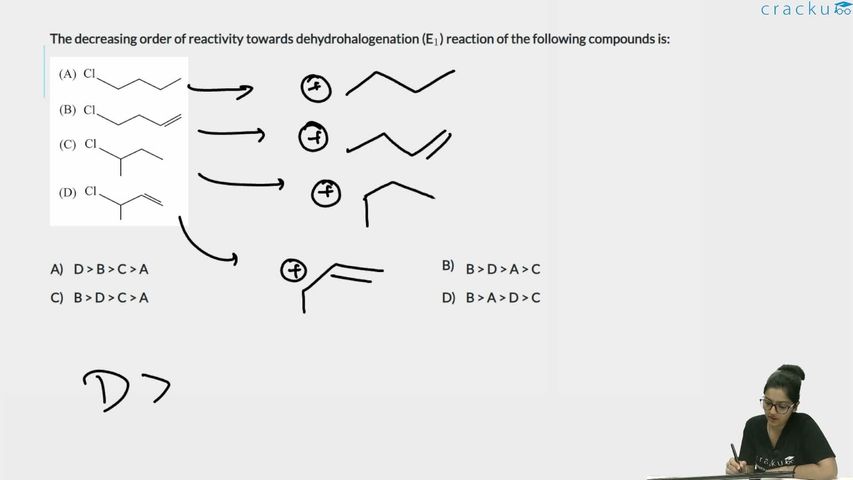
The decreasing order of reactivity towards dehydrohalogenation (E$$_1$$) reaction of the following compounds is:
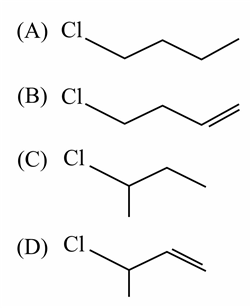
An $$\text{E}1$$ elimination reaction proceeds via a two-step mechanism where the first and rate-determining step (RDS) is the loss of the leaving group ($$\text{Cl}^-$$) to form a carbocation intermediate:
$$\text{Reactivity toward E1} \propto \text{Stability of the Carbocation intermediate}$$
The general order of carbocation stability is: Allylic / Benzylic (resonance stabilized) > Tertiary ($$3^\circ$$) > Secondary ($$2^\circ$$) > Primary ($$1^\circ$$).
Compound (B): Primary Allylic Chloride
Loss of $$\text{Cl}^-$$ yields a primary allylic carbocation ($$\text{CH}_2=\text{CH--CH}_2^+\text{--CH}_2\text{--CH}_3$$ or similar chain system). This carbocation is highly stable because the positive charge is directly delocalized via resonance with the adjacent carbon-carbon double bond. Hence, it is exceptionally reactive.
Compound (D): Secondary Allylic Chloride
Loss of $$\text{Cl}^-$$ forms a secondary allylic-like carbocation. While it has resonance stability, it undergoes minor structural or steric constraint compared to the primary unhindered linear conjugation of B, making it slightly less favored than B but far more stable than non-conjugated carbocations.
Compound (C): Secondary Alkyl Chloride
Loss of $$\text{Cl}^-$$ creates a simple secondary ($$2^\circ$$) carbocation ($$\text{CH}_3\text{--CH}^+\text{--CH}_2\text{--CH}_3$$). It is stabilized purely by hyperconjugation and inductive effects, which are weaker than resonance. It is less reactive than the allylic systems (B and D).
Compound (A): Primary Alkyl Chloride
Loss of $$\text{Cl}^-$$ yields a primary ($$1^\circ$$) carbocation ($$\text{CH}_3\text{--CH}_2\text{--CH}_2\text{--CH}_2\text{--CH}_2^+$$). Primary carbocations are extremely unstable and difficult to form under standard conditions. Thus, it is the least reactive compound.
Arranging the compounds based on the stability profile of their respective carbocations yields the following decreasing order of reactivity:
$$\mathbf{B > D > C > A}$$
Answer: Option — B > D > C > A
Was this solution helpful?
Click on the Email ☝️ to Watch the Video Solution
Create a FREE account and get:
_1.webp)

Educational materials for JEE preparation

Ask our AI anything

AI can make mistakes. Please verify important information.
AI can make mistakes. Please verify important information.
