
Join Our JEE Preparation Group
Prep with like-minded aspirants; Get access to free daily tests and study material.
Sign in
Please select an account to continue using cracku.in
↓ →
Join Our JEE Preparation Group
Prep with like-minded aspirants; Get access to free daily tests and study material.
First, let us recall the precise condition for the appearance of facial-meridional (fac- and mer-) isomerism. The rule is:
An octahedral complex of the general type $$MA_3B_3$$ (three ligands of kind $$A$$ and three of kind $$B)$$
can arrange the three identical ligands so that either all three occupy the corners of one triangular face of the octahedron (the fac form) or lie on one meridian passing through the metal (the mer form). Only such an $$MA_3B_3$$ distribution permits these two distinct spatial dispositions.
With the condition now clearly stated, we inspect each given option one by one, explicitly writing each formula in the required $$MA_xB_y$$ style and checking whether $$x=3,\,y=3$$ inside an octahedral environment.
Option A: $$[\,\mathrm{Co}(NH_3)_4Cl_2\,]^+$$
Here the central metal is $$\mathrm{Co^{III}}$$ in an octahedral field. The ligand count is
$$A = NH_3 \;(4\; \text{times}),$$ $$B = Cl^- \;(2\; \text{times}).$$
Thus the pattern is $$MA_4B_2$$, not $$MA_3B_3$$. Such a complex exhibits only cis-trans isomerism, not fac-mer. Therefore Option A is unsuitable.
Option B: $$[\,\mathrm{Pt}(NH_3)_2Cl_2\,]$$
Platinum in this complex is $$\mathrm{Pt^{II}}$$, which almost always forms a square-planar geometry, not octahedral. Facial-meridional terminology has meaning only for the six-coordinate octahedron, so fac-mer cannot arise here. Hence Option B is ruled out.
Option C: $$[\,\mathrm{Co}Cl_2(en)_2\,]$$
The abbreviation $$en$$ denotes ethylenediamine, a bidentate ligand occupying two sites each. Counting sites:
$$2(en)\;\Rightarrow\;4\text{ sites occupied},$$ $$2Cl^-\;\Rightarrow\;2\text{ sites occupied}.$$
The pattern becomes $$M(A\!-\!A)_2B_2$$ where each $$(A\!-\!A)$$ is bidentate. This arrangement again gives only cis-trans possibilities (now with bidentate ligands) and not the required $$MA_3B_3$$ distribution. So Option C is also unsuitable.
Option D: $$[\,\mathrm{Co}(NH_3)_3(NO_2)_3\,]$$
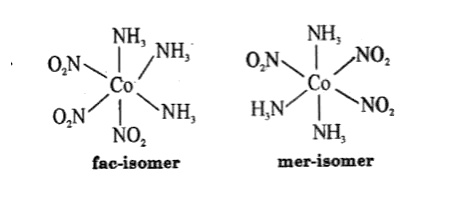
Now we count ligands:
$$A = NH_3 \;(3\; \text{times}),$$ $$B = NO_2^- \;(3\; \text{times}).$$
This is precisely the $$MA_3B_3$$ pattern described in the rule above, and the complex is octahedral because $$\mathrm{Co^{III}}$$ with six monodentate ligands adopts octahedral geometry. Therefore two distinct spatial arrangements exist:
1. The three $$NH_3$$ ligands can occupy corners of one face: the fac isomer.
2. The three $$NH_3$$ ligands can lie along a meridian: the mer isomer.
Hence this complex unmistakably exhibits fac- and mer-isomerism.
After examining every option, only Option D satisfies the necessary condition.
Hence, the correct answer is Option D.
Was this solution helpful?
Create a FREE account and get:
_1.webp)

Educational materials for JEE preparation

Ask our AI anything

AI can make mistakes. Please verify important information.
AI can make mistakes. Please verify important information.
