
Join Our JEE Preparation Group
Prep with like-minded aspirants; Get access to free daily tests and study material.
Sign in
Please select an account to continue using cracku.in
↓ →
Join Our JEE Preparation Group
Prep with like-minded aspirants; Get access to free daily tests and study material.
Some solids dissolve easily, others do not.
a) i) What is the name given to liquids which dissolve solids?
ii) What is the name of the clear liquid formed when a solid dissolves in a liquid?
b) Temperature change affects the solubility of substances in water.
i) How does the solubility of most solids change as the temperature of the water increases?
ii) How does the solubility of a gas change as the temperature of the water increases?
c) Describe how dry solid can be obtained from the liquid in which it is dissolved.
d) The graph shows how the solubility of ammonium sulphate in water changes with temperature.
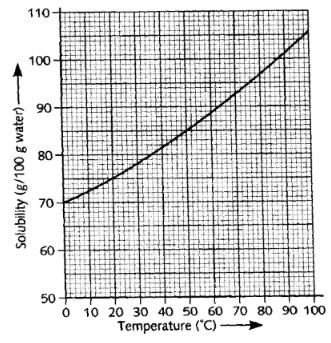
100 g of ammonium sulphate was heated in 100 g of water until it all dissolved. Use the graph to answer the following.
i) What is the lowest temperature at which the water will dissolve all the ammonium sulphate?
ii) What mass of solid will crystallize from the liquid when it is cooled to room temperature?
iii) This solid is filtered off at $$20^\circ\text{C}$$. What will you see if the remaining liquid is then cooled to $$15^\circ\text{C}$$?
iv) What word is used to describe a liquid which cannot dissolve any more solid at a given temperature?
Correct Answer: 85
(a)(i) Solvents. (ii) A solution.<br>(b)(i) The solubility of most solids increases as the temperature rises. (ii) The solubility of a gas decreases as the temperature rises.<br>(c) Heat the solution to evaporate the water (solvent); either evaporate to dryness, or evaporate until crystals start to form, let it cool, filter off the crystals and dry them between filter papers or in a warm oven.<br>(d)(i) The curve reaches $$100\ \text{g}$$ per $$100\ \text{g}$$ of water at about $$85^\circ\text{C}$$, so all the solid dissolves from about $$85^\circ\text{C}$$ upwards.<br>(ii) At room temperature ($$20^\circ\text{C}$$) the solubility is about $$75\ \text{g}$$ per $$100\ \text{g}$$ of water, so about $$100 - 75 = 25\ \text{g}$$ of solid crystallises.<br>(iii) The solubility at $$15^\circ\text{C}$$ is a little lower (about $$74\ \text{g}$$), so a small amount (roughly 1 g) of further crystals appears.<br>(iv) Saturated.
Was this solution helpful?


Predict your JEE Main percentile, rank & performance in seconds

Educational materials for JEE preparation

Ask our AI anything

AI can make mistakes. Please verify important information.
AI can make mistakes. Please verify important information.