Join Our JEE Preparation Group
Prep with like-minded aspirants; Get access to free daily tests and study material.
Sign in
Please select an account to continue using cracku.in
↓ →
Join Our JEE Preparation Group
Prep with like-minded aspirants; Get access to free daily tests and study material.
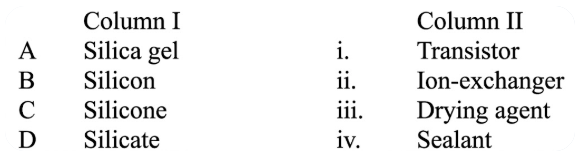
First, let us examine each substance given in Column I and recall its most common technological application. Then we can pair it logically with the descriptions in Column II.
We have $$\text{Silica gel}$$ written against item A. Silica gel is an amorphous, porous form of $$SiO_2$$ having a very high surface area. Because of this large surface area, it adsorbs water vapour readily. Therefore, it is routinely packed in small pouches that are kept in electronic boxes, leather goods, or medicine bottles to keep the contents dry. So its principal function is as a drying agent. In Column II the phrase “drying agent” corresponds to the Roman numeral $$\text{(iii)}$$. Hence we associate
$$A \;-\; \text{Silica gel} \;\longrightarrow\; \text{(iii) Drying agent}$$
Next we consider $$\text{Silicon}$$, item B. When the word “silicon” appears without any modifier, it usually denotes elemental silicon, which is a group-14 semiconductor. Pure or doped silicon wafers are the heart of diodes, transistors, integrated circuits and almost all modern microelectronic devices. Thus its most direct utility among the options listed is “transistor.” In Column II “transistor” carries the Roman numeral $$\text{(i)}$$. Therefore
$$B \;-\; \text{Silicon} \;\longrightarrow\; \text{(i) Transistor}$$
Now we analyse $$\text{Silicone}$$, item C. Silicones (also called polysiloxanes) have the general structural unit $$\big(-Si-O-Si-\big)_n$$ with various organic side groups. Because of their high thermal stability, water repellence and elasticity, silicones are formulated into greases, lubricants and, quite prominently, into sealants used in construction (for filling joints in glass fittings, bathroom tiles, aquaria, etc.). The expression “sealant” appears in Column II with the Roman numeral $$\text{(iv)}$$. Accordingly, we set
$$C \;-\; \text{Silicone} \;\longrightarrow\; \text{(iv) Sealant}$$
Lastly, we have $$\text{Silicate}$$ as item D. Silicates are salts of silicic acid and often exist as complex anionic frameworks such as $$[\;SiO_4^{4-}\;]$$ units. Some specially prepared sodium or hydrogen silicates possess a three-dimensional open-network structure containing exchangeable cations (for example, zeolites). These materials are widely employed in water-softening and as ion-exchange resins in chromatography. Thus the phrase “ion-exchanger” in Column II, labelled $$\text{(ii)}$$, is best matched with silicate. Hence
$$D \;-\; \text{Silicate} \;\longrightarrow\; \text{(ii) Ion-exchanger}$$
Collating all four correspondences we have
$$A \;-\; (iii), \qquad B \;-\; (i), \qquad C \;-\; (iv), \qquad D \;-\; (ii)$$
Looking at the given answer choices, the sequence A - iii, B - i, C - iv, D - ii appears exactly in Option A.
Hence, the correct answer is Option A.
Was this solution helpful?
Create a FREE account and get:
_1.webp)

Educational materials for JEE preparation

Ask our AI anything

AI can make mistakes. Please verify important information.
AI can make mistakes. Please verify important information.