Join Our JEE Preparation Group
Prep with like-minded aspirants; Get access to free daily tests and study material.
Sign in
Please select an account to continue using cracku.in
↓ →
Join Our JEE Preparation Group
Prep with like-minded aspirants; Get access to free daily tests and study material.
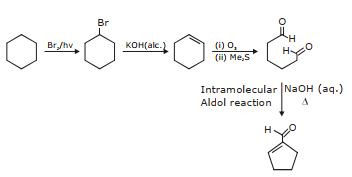
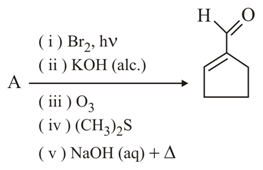
Step 1: Free Radical Substitution
When cyclohexane is treated with bromine in the presence of light ($$\text{Br}_2/h\nu$$), it undergoes photochemical free-radical bromination to form bromocyclohexane:
$$\text{Cyclohexane} \xrightarrow{\text{Br}_2/h\nu} \text{Bromocyclohexane}$$Step 2: Dehydrohalogenation (Formation of A)
When bromocyclohexane is treated with a strong, hot base like alcoholic potassium hydroxide ($$\text{KOH (alc.)}$$), it undergoes an $$\text{E}2$$ elimination reaction. The base abstracts a adjacent proton along with the loss of the bromide leaving group to introduce a carbon-carbon double bond:
$$\text{Bromocyclohexane} \xrightarrow{\text{KOH (alc.)}} \text{Cyclohexene (A)}$$We can confirm that A is cyclohexene by tracking the remaining reactions shown in the diagram:
Was this solution helpful?
Click on the Email ☝️ to Watch the Video Solution
Create a FREE account and get:
_1.webp)

Educational materials for JEE preparation

Ask our AI anything

AI can make mistakes. Please verify important information.
AI can make mistakes. Please verify important information.