
Join Our JEE Preparation Group
Prep with like-minded aspirants; Get access to free daily tests and study material.
Sign in
Please select an account to continue using cracku.in
↓ →
Join Our JEE Preparation Group
Prep with like-minded aspirants; Get access to free daily tests and study material.
The isomer(s) of $$[Co(NH_3)_4Cl_2]$$ that has/have a Cl - Co - Cl angle of 90$$°$$, is/are:
We begin by observing that the complex $$[Co(NH_3)_4Cl_2]$$ contains a total of six monodentate ligands, so an octahedral geometry around the cobalt ion is expected. In an ideal octahedron every bond angle between adjacent (neighbouring) coordination positions is $$90^{\circ}$$, and the angle between diametrically opposite positions is $$180^{\circ}$$.
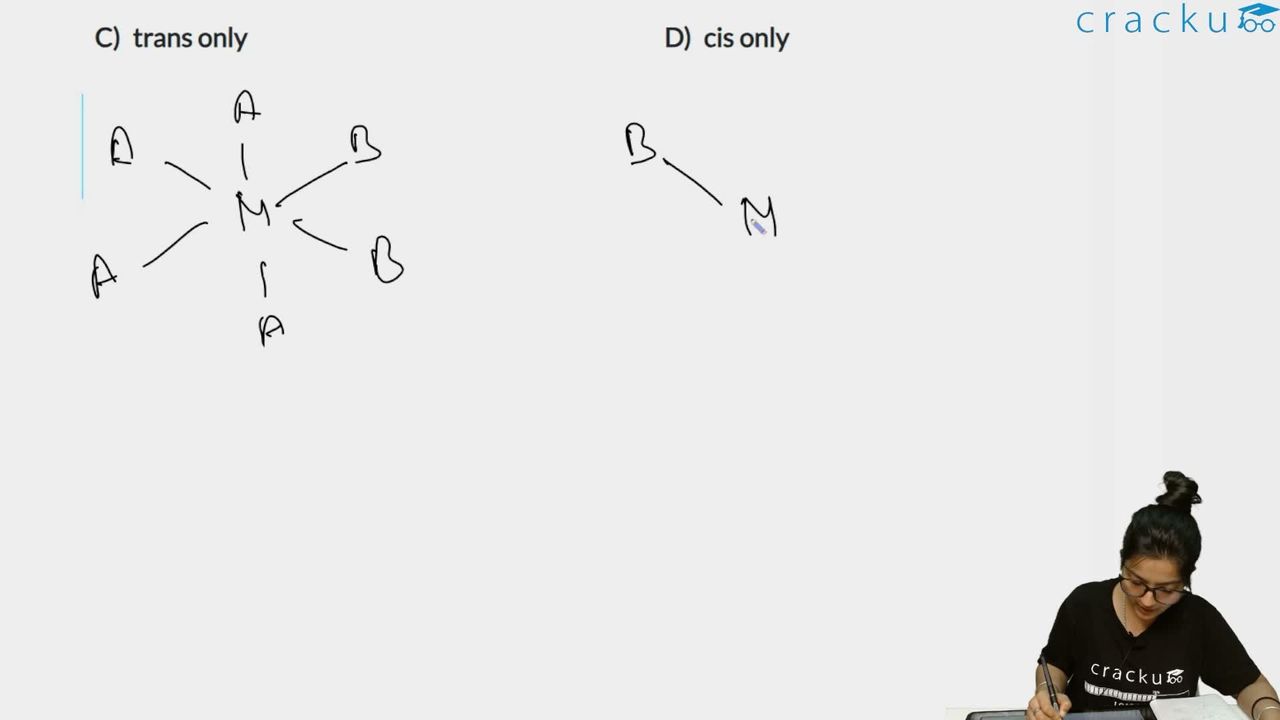
Because there are only two chloride ligands and the remaining four ligands are ammonia molecules, there are exactly two possible spatial arrangements for the two chlorides:
1. Cis arrangement. The two $$Cl^{-}$$ ligands occupy adjacent positions on the octahedron. Since adjacent positions subtend an angle of $$90^{\circ}$$ at the central metal, the Cl - Co - Cl angle in the cis isomer is $$90^{\circ}$$.
2. Trans arrangement. The two $$Cl^{-}$$ ligands occupy positions that are directly opposite each other. Opposite positions in an octahedron make an angle of $$180^{\circ}$$ at the metal centre, so the Cl - Co - Cl angle in the trans isomer is $$180^{\circ}$$.
No other distinct octahedral arrangements are possible with the ligand set $$NH_3$$ (four copies) and $$Cl^{-}$$ (two copies). In particular, the “fac” (facial) and “mer” (meridional) descriptions apply only to complexes of the type $$MA_3B_3$$ (three ligands of each kind), so they do not exist for $$[Co(NH_3)_4Cl_2]$$.
From the above discussion we see that a Cl - Co - Cl bond angle of $$90^{\circ}$$ appears only in the cis isomer, while the trans isomer has an angle of $$180^{\circ}$$.
Hence, the correct answer is Option D.
Was this solution helpful?
Click on the Email ☝️ to Watch the Video Solution
Create a FREE account and get:
_1.webp)

Educational materials for JEE preparation

Ask our AI anything

AI can make mistakes. Please verify important information.
AI can make mistakes. Please verify important information.
