
Join Our JEE Preparation Group
Prep with like-minded aspirants; Get access to free daily tests and study material.
Sign in
Please select an account to continue using cracku.in
↓ →
Join Our JEE Preparation Group
Prep with like-minded aspirants; Get access to free daily tests and study material.
The correct order of the spin-only magnetic moments of the following complexes is:
(I) $$[Cr(H_2O)_6]Br_2$$
(II) $$Na_4[Fe(CN)_6]$$
(III) $$Na_3[Fe(C_2O_4)_3]$$ $$(\Delta_0 \gt P)$$
(IV) $$(Et_4N)_2[CoCl_4]$$
To compare the spin-only magnetic moments ($$\mu_{\text{spin}}$$) of the four complexes we recall the formula
$$ \mu_{\text{spin}}= \sqrt{n(n+2)}\; \text{B.M.} $$
where $$n$$ is the number of unpaired electrons in the metal ion after considering ligand field effects (high-spin or low-spin, octahedral or tetrahedral).
We now treat every complex one by one, always determining
(i) the oxidation state of the metal,
(ii) the d-electron count,
(iii) whether the environment is high-spin or low-spin,
(iv) the exact number $$n$$ of unpaired electrons, and finally
(v) the value of $$\mu_{\text{spin}}$$.
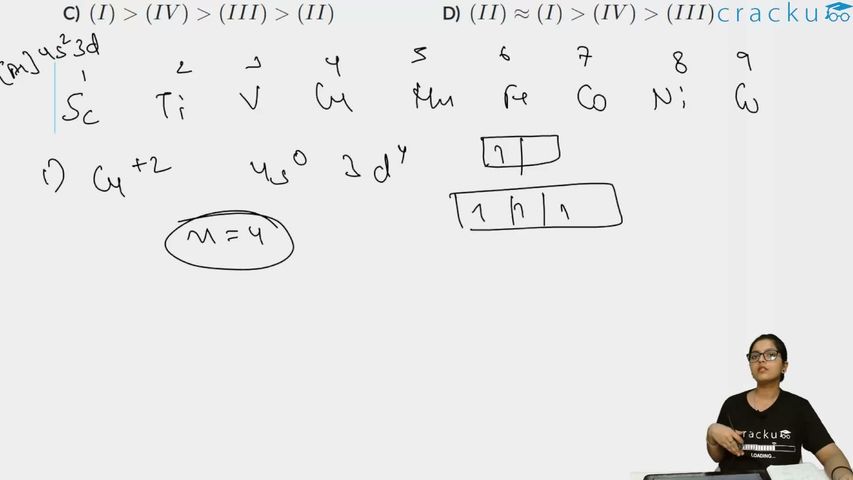
(I) $$[Cr(H_2O)_6]Br_2$$
The two bromide ions are counter-ions, so the complex cation is $$[Cr(H_2O)_6]^{2+}$$. Water is neutral, hence
$$ \text{Oxidation state of Cr}=+2. $$
The ground-state electronic configuration of a neutral chromium atom is $$[Ar]\,3d^5\,4s^1$$. Removing two electrons (to give Cr2+) we obtain
$$ \text{Cr}^{2+}: [Ar]\,3d^4. $$
The cation is octahedral and $$H_2O$$ is a weak-field ligand, so we obtain a high-spin $$d^4$$ pattern:
$$ t_{2g}^3e_g^1, $$
with one electron in each of the five d-orbitals except one empty orbital; hence
$$ n=4. $$
Substituting in the formula,
$$ \mu_{\text{spin}}=\sqrt{4(4+2)}=\sqrt{24}\;\text{B.M.}\approx 4.90\;\text{B.M.} $$
(II) $$Na_4[Fe(CN)_6]$$
The anion is $$[Fe(CN)_6]^{4-}$$. With each $$CN^-$$ contributing -1, the iron is
$$ \text{Fe oxidation state}=+2. $$
So $$d$$-electron count is $$d^6$$. $$CN^-$$ is a strong-field ligand; the complex is octahedral and low-spin ($$\Delta_0\gt P$$). The electron distribution is therefore
$$ t_{2g}^6e_g^0, $$
in which all six electrons are paired. Thus
$$ n=0,\qquad \mu_{\text{spin}}=\sqrt{0(0+2)}=0\;\text{B.M.} $$
(III) $$Na_3[Fe(C_2O_4)_3]$$ with $$(\Delta_0\gt P)$$
The anion is $$[Fe(C_2O_4)_3]^{3-}$$. Since each oxalate ion is $$C_2O_4^{2-}$$, the algebra gives
$$ -6 + (\text{oxidation state of Fe}) = -3 \;\;\Longrightarrow\;\; \text{Fe}=+3. $$
So the metal ion is $$d^5$$. The statement $$(\Delta_0\gt P)$$ tells us the complex is low-spin. Thus for low-spin $$d^5$$ in an octahedral field we have
$$ t_{2g}^5e_g^0. $$
Here four electrons pair up in two orbitals and one electron remains unpaired in the third, giving
$$ n=1. $$
Hence
$$ \mu_{\text{spin}}=\sqrt{1(1+2)}=\sqrt{3}\;\text{B.M.}\approx 1.73\;\text{B.M.} $$
(IV) $$(Et_4N)_2[CoCl_4]$$
The anion is $$[CoCl_4]^{2-}$$. With four chloride ligands each at -1 we have
$$ -4 + (\text{oxidation state of Co}) = -2 \;\;\Longrightarrow\;\; \text{Co}=+2. $$
Thus Co2+ is $$d^7$$. The geometry is tetrahedral; in tetrahedral fields the splitting is always small (weak-field), so the complex is high-spin. For a high-spin $$d^7$$ tetrahedral ion the filling is
$$ e^4t_2^3, $$
where the four electrons in the lower $$e$$ set are all paired, while the three electrons in the upper $$t_2$$ set occupy separate orbitals. Consequently
$$ n=3. $$
The spin-only moment is therefore
$$ \mu_{\text{spin}}=\sqrt{3(3+2)}=\sqrt{15}\;\text{B.M.}\approx 3.87\;\text{B.M.} $$
Collecting all four values:
$$ (I):\;4.90\;\text{B.M.}\quad\gt\quad (IV):\;3.87\;\text{B.M.}\quad\gt\quad (III):\;1.73\;\text{B.M.}\quad\gt\quad (II):\;0\;\text{B.M.} $$
The descending (or “greatest to least”) order of spin-only magnetic moment is therefore
$$ (I) \; \gt \; (IV) \; \gt \; (III) \; \gt \; (II). $$
This matches the sequence given in Option C.
Hence, the correct answer is Option C.
Was this solution helpful?
Click on the Email ☝️ to Watch the Video Solution
Create a FREE account and get:
_1.webp)

Educational materials for JEE preparation

Ask our AI anything

AI can make mistakes. Please verify important information.
AI can make mistakes. Please verify important information.
