Here is the clean explanation, completely free of math formatting or special text tags, so you can copy and paste it directly.
Breakdown of Each Compound
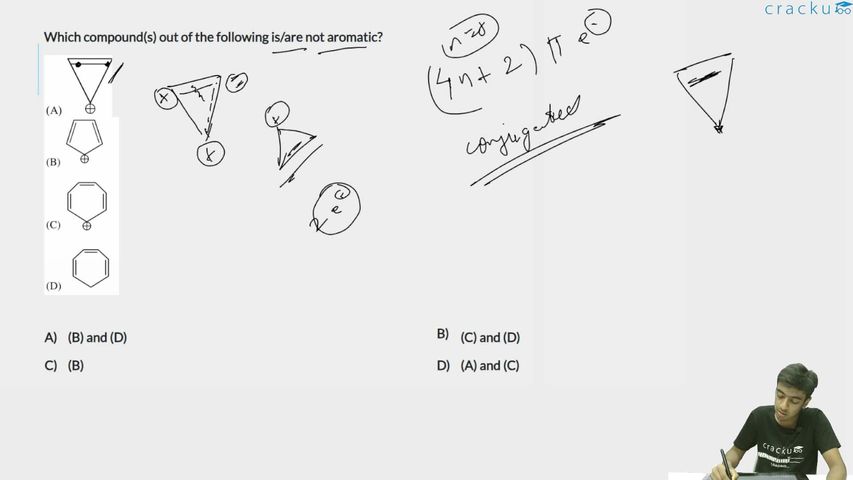
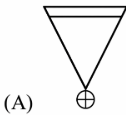
(A) Cyclopropenyl cation
- Structure: A 3-membered ring with one double bond and a carbocation.
- Conjugation: It is cyclic, planar, and completely conjugated because the positive charge allows the electrons to delocalize around the entire ring.
- Pi-electrons: It has 2 pi-electrons from the single double bond.
- Classification: It follows Huckel's rule (4n + 2 pi-electrons where n = 0). Therefore, it is Aromatic.
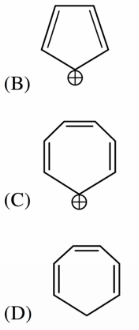
(B) Cyclopentadienyl cation
- Structure: A 5-membered ring with two double bonds and a carbocation.
- Conjugation: It is cyclic, planar, and completely conjugated.
- Pi-electrons: It has 4 pi-electrons from the two double bonds.
- Classification: It follows the 4n pi-electron rule (where n = 1). Therefore, it is Antiaromatic (Not aromatic).
(C) Cycloheptatrienyl cation (Tropylium ion)
- Structure: A 7-membered ring with three double bonds and a carbocation.
- Conjugation: It is cyclic, planar, and completely conjugated. The positive charge allows the pi-electrons to delocalize freely across all seven carbons.
- Pi-electrons: It has 6 pi-electrons from the three double bonds.
- Classification: It perfectly follows Huckel's rule (4n + 2 pi-electrons where n = 1). Therefore, it is Aromatic.
(D) Cycloheptatriene
- Structure: A 7-membered ring with three double bonds and one CH2 carbon.
- Conjugation: The CH2 carbon at the bottom is sp3 hybridized. This breaks the continuous cyclic loop of conjugation.
- Classification: Because it lacks complete cyclic conjugation, it is Non-aromatic (Not aromatic).
Final Summary
- Aromatic: (A) and (C)
- Not Aromatic: (B) and (D)