
Join Our JEE Preparation Group
Prep with like-minded aspirants; Get access to free daily tests and study material.
Sign in
Please select an account to continue using cracku.in
↓ →
Join Our JEE Preparation Group
Prep with like-minded aspirants; Get access to free daily tests and study material.
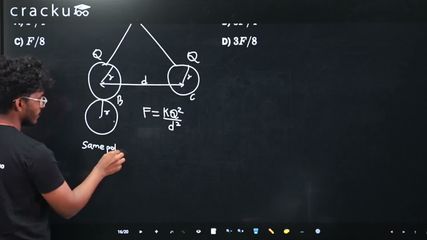
Two spherical conductor $$B$$ and $$C$$ having equal radii and carrying equal charges in them repel each other with a force $$F$$ when kept apart at some distance. A third spherical conductor having same radius as that of $$B$$ but uncharged brought in contact with $$B$$, then brought in contact with $$C$$ and finally removed away from both. The new force of repulsion, between $$B$$ and $$C$$ is
Let the initial charges on the identical spherical conductors $$B$$ and $$C$$ be $$Q$$.
Let the distance between their centers be $$r$$.
The initial force of repulsion $$F$$ between them is given by Coulomb's Law:
$$F = k \frac{Q \cdot Q}{r^2} = k \frac{Q^2}{r^2}$$
Let the third identical, uncharged sphere be $$A$$. Its initial charge is $$0$$.
{Step 1: Sphere $$A$$ is brought in contact with $$B$$}
When two identical conductors are brought into contact, they share the total charge equally due to symmetry.
The new charge on $$B$$ ($$Q_B'$$) and the new charge on $$A$$ ($$Q_A'$$) will be the average of their initial charges:
$$Q_B' = Q_A' = \frac{Q + 0}{2} = \frac{Q}{2}$$
{Step 2: Sphere $$A$$ is brought in contact with $$C$$}
Sphere $$A$$ now carries a charge of $$\frac{Q}{2}$$. When it touches $$C$$ (which still has its original charge of $$Q$$), they will again share the total charge equally.
The new charge on $$C$$ ($$Q_C'$$) and the final charge on $$A$$ will be:
$$Q_C' = \frac{Q_A' + Q_C}{2} = \frac{\frac{Q}{2} + Q}{2} = \frac{\frac{3Q}{2}}{2} = \frac{3Q}{4}$$
{Step 3: Calculating the new force}
Sphere $$A$$ is now removed. The final charges on the remaining spheres are:
Final charge on $$B$$: $$Q_B' = \frac{Q}{2}$$
Final charge on $$C$$: $$Q_C' = \frac{3Q}{4}$$
The distance $$r$$ remains unchanged. The new force of repulsion $$F'$$ between $$B$$ and $$C$$ is:
$$F' = k \frac{Q_B' \cdot Q_C'}{r^2}$$
Substitute the new charge values:
$$F' = k \frac{\left(\frac{Q}{2}\right) \cdot \left(\frac{3Q}{4}\right)}{r^2}$$
$$F' = k \frac{3Q^2}{8r^2}$$
Factor out the constant fraction:
$$F' = \frac{3}{8} \left( k \frac{Q^2}{r^2} \right)$$
Since the term in the parentheses is exactly our initial force $$F$$, we substitute it back in:
$$F' = \frac{3}{8}F$$
Was this solution helpful?
Click on the Email ☝️ to Watch the Video Solution
Create a FREE account and get:
_1.webp)

Educational materials for JEE preparation

Ask our AI anything

AI can make mistakes. Please verify important information.
AI can make mistakes. Please verify important information.
