
Join Our JEE Preparation Group
Prep with like-minded aspirants; Get access to free daily tests and study material.
Sign in
Please select an account to continue using cracku.in
↓ →
Join Our JEE Preparation Group
Prep with like-minded aspirants; Get access to free daily tests and study material.
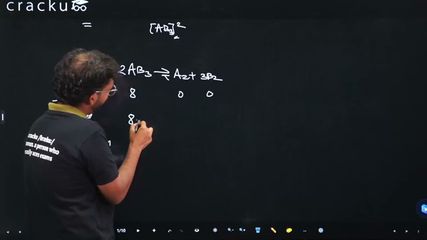
$$8$$ mol of $$AB_3(g)$$ are introduced into a $$1.0$$ dm$$^3$$ vessel. If it dissociates as $$2AB_3(g) \rightleftharpoons A_2(g) + 3B_2(g)$$. At equilibrium, $$2$$ mol of $$A_2$$ are found to be present. The equilibrium constant of this reaction is
The balanced dissociation is
$$2\,AB_3(g) \rightleftharpoons A_2(g)+3\,B_2(g)$$
Initial moles (in a 1 dm$$^3$$ vessel):
$$[AB_3]_0 = 8\ \text{mol},\qquad [A_2]_0 = 0,\qquad [B_2]_0 = 0$$
Let the extent of reaction be $$\xi$$ mol:
For every $$\xi$$ mol of $$A_2$$ produced, the stoichiometry gives
• $$2\xi$$ mol of $$AB_3$$ are consumed
• $$3\xi$$ mol of $$B_2$$ are produced.
Equilibrium moles:
$$[AB_3]_{\text{eq}} = 8 - 2\xi$$
$$[A_2]_{\text{eq}} = \xi$$
$$[B_2]_{\text{eq}} = 3\xi$$
The question states that 2 mol of $$A_2$$ are present at equilibrium, so
$$\xi = 2$$
Substituting $$\xi = 2$$:
$$[AB_3]_{\text{eq}} = 8 - 2(2) = 4$$
$$[A_2]_{\text{eq}} = 2$$
$$[B_2]_{\text{eq}} = 3(2) = 6$$
The vessel volume is 1 dm$$^3$$, hence the numerical values above are also the molar concentrations (mol dm$$^{-3}$$).
Expression for the equilibrium constant:
$$K_c = \frac{[A_2]\,[B_2]^3}{[AB_3]^2}$$
Insert the equilibrium concentrations:
$$K_c = \frac{(2)\,(6)^3}{(4)^2} = \frac{2 \times 216}{16} = \frac{432}{16} = 27$$
Therefore, the equilibrium constant is $$27$$.
Option C which is: $$27$$
Was this solution helpful?
Click on the Email ☝️ to Watch the Video Solution
Create a FREE account and get:
_1.webp)

Educational materials for JEE preparation

Ask our AI anything

AI can make mistakes. Please verify important information.
AI can make mistakes. Please verify important information.
