
Join Our JEE Preparation Group
Prep with like-minded aspirants; Get access to free daily tests and study material.
Sign in
Please select an account to continue using cracku.in
↓ →
Join Our JEE Preparation Group
Prep with like-minded aspirants; Get access to free daily tests and study material.
A sphere of mass 2 kg and radius 0.5 m is rolling with an initial speed of 1 m s$$^{-1}$$ goes up an inclined plane which makes an angle of 30° with the horizontal plane, without slipping. How low will the sphere take to return to the starting point $$A$$?
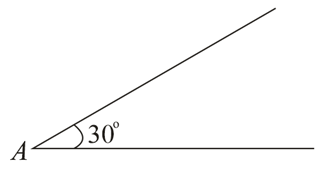
We need to determine the total time it takes for a solid rolling sphere to travel up an inclined plane and return to its starting point $$A$$.
From the problem statement, we have:
For a solid uniform sphere, the moment of inertia about its center is given by:
$$I = \frac{2}{5}mR^2$$
When an object rolls up an inclined plane without slipping, both gravity and static friction act on it. The linear acceleration ($$a$$) of a rolling body down an incline is given by the formula:
$$a = \frac{g \sin\theta}{1 + \frac{I}{mR^2}}$$
Substitute the ratio $$\frac{I}{mR^2} = \frac{2}{5}$$ into the acceleration formula:
$$a = \frac{g \sin 30^\circ}{1 + \frac{2}{5}} = \frac{g \left(\frac{1}{2}\right)}{\frac{7}{5}} = \frac{5}{14}g$$
Plugging in $$g = 9.8\text{ m s}^{-2}$$:
$$a = \frac{5}{14} \times 9.8 = 5 \times 0.7 = 3.5\text{ m s}^{-2}$$
Let $$t_1$$ be the time taken by the sphere to come to rest at the highest point of its climb. Using the first equation of motion ($$v = u - at_1$$) where final velocity $$v = 0$$:
$$0 = 1 - 3.5 \cdot t_1 \implies t_1 = \frac{1}{3.5} = \frac{2}{7}\text{ s}$$
Since the system is conservative and rolls without slipping in both directions, the time of ascent ($$t_1$$) equals the time of descent ($$t_2$$). Therefore, the total round-trip time ($$T$$) to return to point $$A$$ is:
$$T = 2 \cdot t_1 = 2 \times \frac{2}{7} = \frac{4}{7}\text{ s} \approx 0.571\text{ s}$$
Rounding to two decimal places closest to the calculated metric options yields approximately $$0.56\text{ s}$$.
The total time the sphere takes to return to the starting point is 0.56 s, which corresponds to Option C.
Was this solution helpful?
Click on the Email ☝️ to Watch the Video Solution
Create a FREE account and get:
_1.webp)

Educational materials for JEE preparation

Ask our AI anything

AI can make mistakes. Please verify important information.
AI can make mistakes. Please verify important information.


