
Join Our JEE Preparation Group
Prep with like-minded aspirants; Get access to free daily tests and study material.
Sign in
Please select an account to continue using cracku.in
↓ →
Join Our JEE Preparation Group
Prep with like-minded aspirants; Get access to free daily tests and study material.
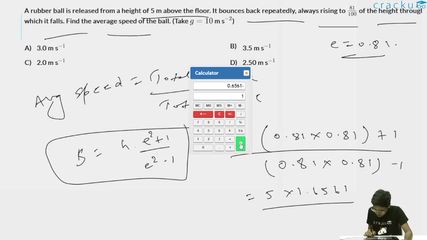
A rubber ball is released from a height of 5 m above the floor. It bounces back repeatedly, always rising to $$\frac{81}{100}$$ of the height through which it falls. Find the average speed of the ball. (Take $$g = 10$$ m s$$^{-2}$$)
The ball is released from a height $$h = 5$$ m and the coefficient of restitution squared is $$e^2 = \frac{81}{100}$$, so $$e = \frac{9}{10}$$. After each bounce the ball rises to $$e^2$$ times the previous height.
The total distance travelled is $$S = h + 2he^2 + 2he^4 + \cdots = h + \frac{2he^2}{1 - e^2} = h \cdot \frac{1 + e^2}{1 - e^2}$$. Substituting, $$S = 5 \times \frac{1 + 0.81}{1 - 0.81} = 5 \times \frac{1.81}{0.19} = 47.63$$ m.
The total time is $$T = \sqrt{\frac{2h}{g}} + 2\sqrt{\frac{2h}{g}}(e + e^2 + e^3 + \cdots) = \sqrt{\frac{2h}{g}}\left(1 + \frac{2e}{1 - e}\right) = \sqrt{\frac{2h}{g}} \cdot \frac{1 + e}{1 - e}$$. With $$\sqrt{\frac{2 \times 5}{10}} = 1$$ s, we get $$T = 1 \times \frac{1.9}{0.1} = 19$$ s.
The average speed is $$\frac{S}{T} = \frac{47.63}{19} \approx 2.50$$ m s$$^{-1}$$.
Was this solution helpful?
Click on the Email ☝️ to Watch the Video Solution
Create a FREE account and get:
_1.webp)

Educational materials for JEE preparation

Ask our AI anything

AI can make mistakes. Please verify important information.
AI can make mistakes. Please verify important information.


