
Join Our JEE Preparation Group
Prep with like-minded aspirants; Get access to free daily tests and study material.
Sign in
Please select an account to continue using cracku.in
↓ →
Join Our JEE Preparation Group
Prep with like-minded aspirants; Get access to free daily tests and study material.
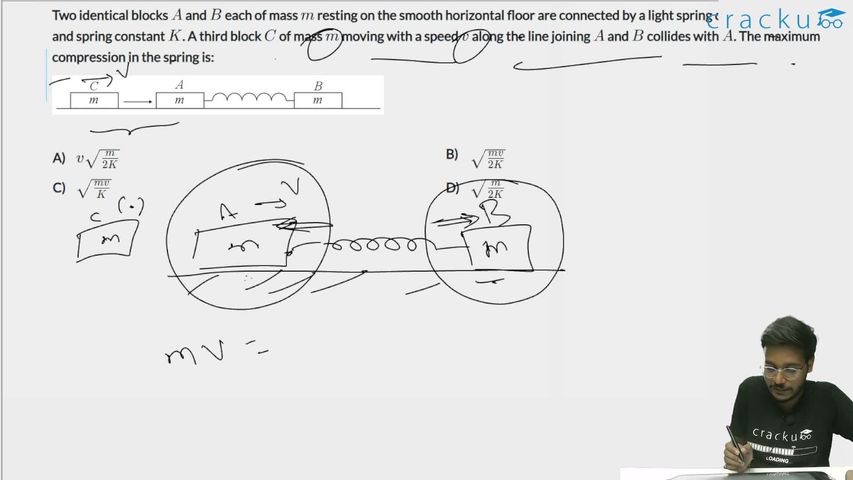
Two identical blocks $$A$$ and $$B$$ each of mass $$m$$ resting on the smooth horizontal floor are connected by a light spring of natural length $$L$$ and spring constant $$K$$. A third block $$C$$ of mass $$m$$ moving with a speed $$v$$ along the line joining $$A$$ and $$B$$ collides with $$A$$. The maximum compression in the spring is:

We need to determine the maximum compression in the spring after block $$C$$ collides with block $$A$$.
From the layout shown on the, block $$C$$ of mass $$m$$ moving with velocity $$v$$ makes a head-on collision with an identical stationary block $$A$$ (mass $$m$$).
Assuming the collision is perfectly elastic (standard for such idealized physics problems):
As block $$A$$ moves to the right, it begins to compress the spring connecting it to block $$B$$. This compression exerts a forward force on block $$B$$ (speeding it up) and a backward force on block $$A$$ (slowing it down).
The spring reaches its maximum compression ($$x_{\text{max}}$$) at the exact instant when both blocks $$A$$ and $$B$$ are moving with the exact same common velocity ($$V_c$$). At this point, relative motion between them temporarily stops.
$$m \cdot v = (m + m) \cdot V_c$$
$$m v = 2m V_c \implies V_c = \frac{v}{2}$$
$$\frac{1}{2} m v^2 = \frac{1}{2} (2m) V_c^2 + \frac{1}{2} K x_{\text{max}}^2$$
Substitute $$V_c = \frac{v}{2}$$ into the energy conservation equation:
$$\frac{1}{2} m v^2 = \frac{1}{2} (2m) \left(\frac{v}{2}\right)^2 + \frac{1}{2} K x_{\text{max}}^2$$
Multiply the entire equation by 2 to clear the fractions:
$$m v^2 = 2m \left(\frac{v^2}{4}\right) + K x_{\text{max}}^2$$
$$m v^2 = \frac{1}{2} m v^2 + K x_{\text{max}}^2$$
Isolate the spring term:
$$K x_{\text{max}}^2 = m v^2 - \frac{1}{2} m v^2$$
$$K x_{\text{max}}^2 = \frac{1}{2} m v^2$$
$$x_{\text{max}}^2 = \frac{m v^2}{2K}$$
Taking the square root gives us the maximum compression:
$$x_{\text{max}} = v \sqrt{\frac{m}{2K}}$$
The maximum compression in the spring is $$v \sqrt{\frac{m}{2K}}$$, which corresponds to Option A.
Was this solution helpful?
Click on the Email ☝️ to Watch the Video Solution
Create a FREE account and get:
_1.webp)

Educational materials for JEE preparation

Ask our AI anything

AI can make mistakes. Please verify important information.
AI can make mistakes. Please verify important information.


