For the following questions answer them individually
The velocity of a particle is $$v = (v_0 + gt + Ft^2)$$ m s$$^{-1}$$. Its position is $$x = 0$$ at $$t = 0$$; then its displacement after time ($$t = 1$$ s) is:
Two identical blocks $$A$$ and $$B$$ each of mass $$m$$ resting on the smooth horizontal floor are connected by a light spring of natural length $$L$$ and spring constant $$K$$. A third block $$C$$ of mass $$m$$ moving with a speed $$v$$ along the line joining $$A$$ and $$B$$ collides with $$A$$. The maximum compression in the spring is:
A rubber ball is released from a height of 5 m above the floor. It bounces back repeatedly, always rising to $$\frac{81}{100}$$ of the height through which it falls. Find the average speed of the ball. (Take $$g = 10$$ m s$$^{-2}$$)
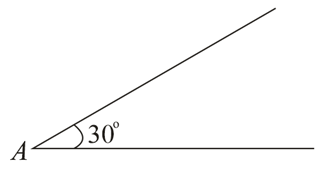
A sphere of mass 2 kg and radius 0.5 m is rolling with an initial speed of 1 m s$$^{-1}$$ goes up an inclined plane which makes an angle of 30° with the horizontal plane, without slipping. How low will the sphere take to return to the starting point $$A$$?
A geostationary satellite is orbiting around an arbitrary planet $$P$$ at a height of $$11R$$ above the surface of $$P$$, $$R$$ being the radius of $$P$$. The time period of another satellite in hours at a height of $$2R$$ from the surface of $$P$$ is ________. has the time period of 24 hours.
An object is located at 2 km beneath the surface of the water. If the fractional compression $$\frac{\Delta V}{V}$$ is 1.36%, the ratio of hydraulic stress to the corresponding hydraulic strain will be ________. [Given: density of water is 1000 kg m$$^{-3}$$ and $$g = 9.8$$ m s$$^{-2}$$].
Which one is the correct option for the two different thermodynamic processes?
If one mole of the polyatomic gas is having two vibrational modes and $$\beta$$ is the ratio of molar specific heats for polyatomic gas $$\left(\beta = \frac{C_p}{C_v}\right)$$ then the value of $$\beta$$ is:
A block of mass 1 kg attached to a spring is made to oscillate with an initial amplitude of 12 cm. After 2 minutes the amplitude decreases to 6 cm. Determine the value of the damping constant for this motion. (take $$\ln 2 = 0.693$$)
Two particles $$A$$ and $$B$$ of equal masses are suspended from two massless springs of spring constants $$K_1$$ and $$K_2$$ respectively. If the maximum velocities during oscillations are equal, the ratio of the amplitude of $$A$$ and $$B$$ is: