
Join Our JEE Preparation Group
Prep with like-minded aspirants; Get access to free daily tests and study material.
Sign in
Please select an account to continue using cracku.in
↓ →
Join Our JEE Preparation Group
Prep with like-minded aspirants; Get access to free daily tests and study material.
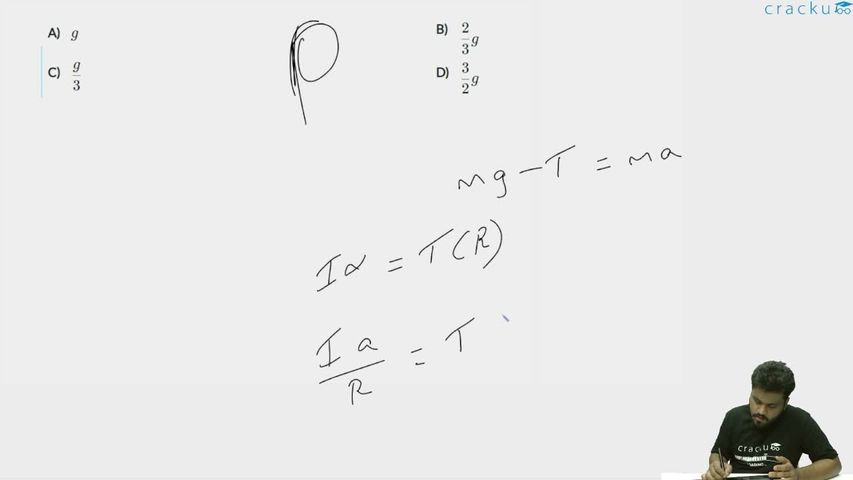
A mass $$m$$ hangs with the help of a string wrapped around a pulley on a frictionless bearing. The pulley has mass $$m$$ and radius $$R$$. Assuming pulley to be a perfect uniform circular disc, the acceleration of the mass $$m$$, if the string does not slip on the pulley, is:
To find the acceleration of the hanging mass, we can analyze the forces and torques acting on the system.
Let the tension in the string be T and the downward linear acceleration of the mass be a.
The forces acting on the hanging mass are gravity acting downwards and tension acting upwards. Applying Newton's second law:
$$mg - T = ma$$The pulley is a uniform circular disc of mass m and radius R. Its moment of inertia I about its central axis is:
$$I = \frac{1}{2}mR^2$$The torque tau on the pulley is provided by the tension T of the string at radius R:
$$\tau = TR$$
Applying the rotational form of Newton's second law ($$\tau = I\alpha$$, where $$\alpha$$ is the angular acceleration):
$$TR = I\alpha$$
$$TR = \left(\frac{1}{2}mR^2\right)\alpha$$
Since the string does not slip on the pulley, the linear acceleration a of the mass is related to the angular acceleration $$\alpha$$ of the pulley by:
$$a = \alpha R$$Dividing both sides by R gives the expression for tension:
$$T = \frac{1}{2}ma$$
Move all terms containing acceleration a to one side:
$$mg = ma + \frac{1}{2}ma$$
$$mg = \frac{3}{2}ma$$
Cancel the mass m from both sides:
$$g = \frac{3}{2}a$$
Solve for acceleration a:
$$a = \frac{2}{3}g$$
Was this solution helpful?
Click on the Email ☝️ to Watch the Video Solution
Create a FREE account and get:
_1.webp)

Educational materials for JEE preparation

Ask our AI anything

AI can make mistakes. Please verify important information.
AI can make mistakes. Please verify important information.


