Join Our JEE Preparation Group
Prep with like-minded aspirants; Get access to free daily tests and study material.
Sign in
Please select an account to continue using cracku.in
↓ →
Join Our JEE Preparation Group
Prep with like-minded aspirants; Get access to free daily tests and study material.
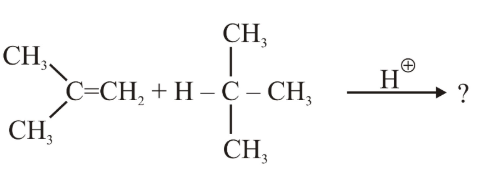
The reaction shown is an acid-catalysed alkylation reaction used industrially for preparation of highly branched alkanes.
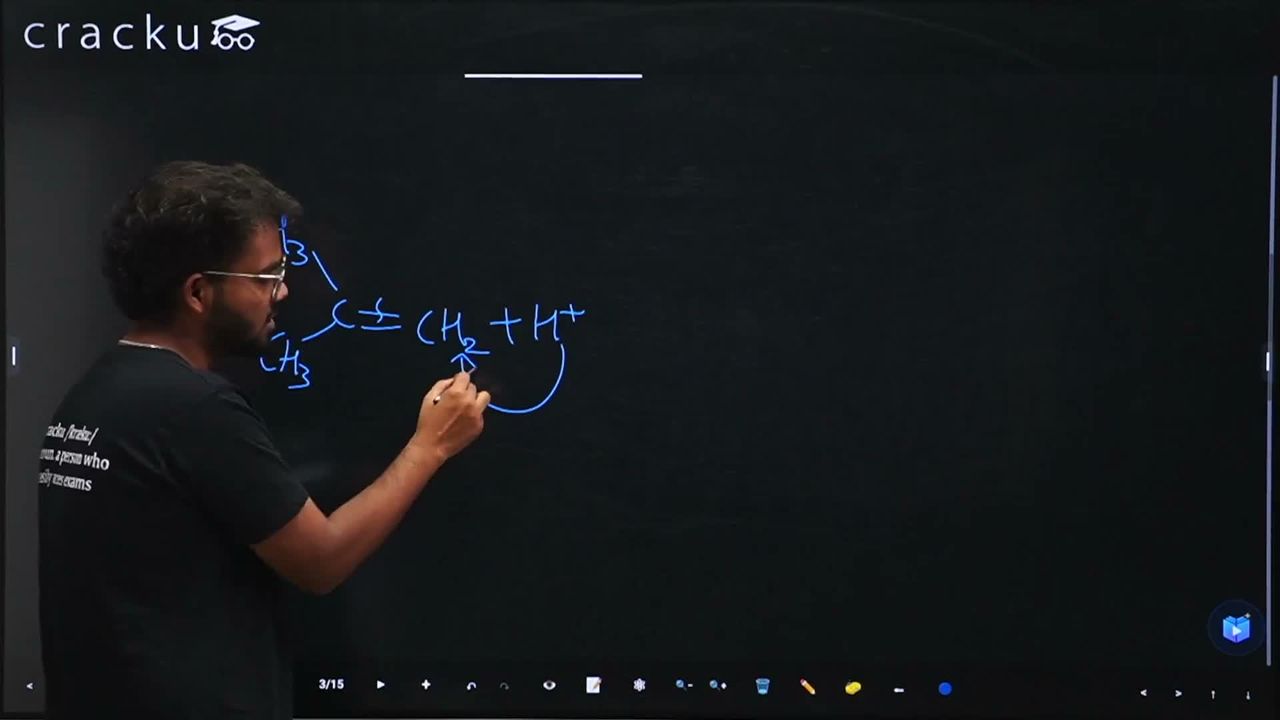
The acid catalyst $$\mathrm{(H^+)}$$ protonates the double bond of $$\mathrm{2\text{-}Methylpropene}$$.
According to Markovnikov’s rule, protonation generates a highly stable tertiary carbocation $$\mathrm{(CH_3)_3C^+}$$.
This tert-butyl carbocation attacks another molecule of isobutylene, forming a larger $$\mathrm{C_8}$$ tertiary carbocation intermediate.
A hydride transfer then occurs from $$\mathrm{Isobutane}$$ to the carbocation.
This neutralises the intermediate and regenerates the tert-butyl carbocation.
The final major product formed is $$\mathrm{2,2,4\text{-}Trimethylpentane}$$, commonly called $$\mathrm{Isooctane}$$.
Its condensed structural formula is $$\mathrm{(CH_3)_3C-CH_2-CH(CH_3)_2}$$.
Was this solution helpful?
Click on the Email ☝️ to Watch the Video Solution
Create a FREE account and get:
_1.webp)

Educational materials for JEE preparation

Ask our AI anything

AI can make mistakes. Please verify important information.
AI can make mistakes. Please verify important information.