Join Our JEE Preparation Group
Prep with like-minded aspirants; Get access to free daily tests and study material.
Sign in
Please select an account to continue using cracku.in
↓ →
Join Our JEE Preparation Group
Prep with like-minded aspirants; Get access to free daily tests and study material.
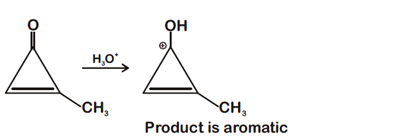
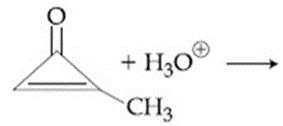
Protonation of the Carbonyl Oxygen:
The lone pair of electrons on the carbonyl oxygen atom attacks a proton from $$\text{H}_3\text{O}^\oplus$$. This forms a protonated conjugate acid intermediate:
$$\text{R}_2\text{C=O} + \text{H}^\oplus \rightleftharpoons [\text{R}_2\text{C=}\overset{\oplus}{\text{O}}\text{H} \longleftrightarrow \text{R}_2\overset{\oplus}{\text{C}}\text{--OH}]$$Resonance Stabilization via Aromaticity:
By shifting the $$\pi$$-electrons of the carbonyl double bond completely onto the electronegative oxygen atom, a highly stable resonance contributor is generated. This structures a cyclopropenyl cation ring core:
$$\text{2-methylcycloprop-2-en-1-ol cation}$$This cyclic intermediate contains a continuously conjugated planar loop of 3 $$sp^2$$ hybridized carbon atoms sharing exactly $$2\,\pi$$ electrons. According to Hückel's Rule ($$4n + 2$$ where $$n = 0$$), this ring system possesses immense thermodynamic stability due to its aromatic character.
The major species remains locked in its protonated, highly stable aromatic hydroxy-functionalized cyclopropenium form rather than reverting or undergoing ring-opening.
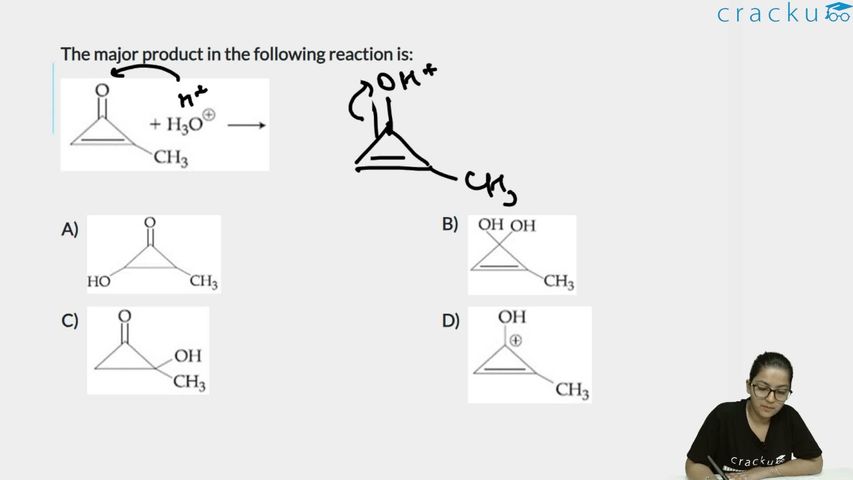
Answer: Option D (The protonated aromatic cyclopropenium cation structure)
Was this solution helpful?
Click on the Email ☝️ to Watch the Video Solution
Create a FREE account and get:
_1.webp)

Educational materials for JEE preparation

Ask our AI anything

AI can make mistakes. Please verify important information.
AI can make mistakes. Please verify important information.