
Join Our JEE Preparation Group
Prep with like-minded aspirants; Get access to free daily tests and study material.
Sign in
Please select an account to continue using cracku.in
↓ →
Join Our JEE Preparation Group
Prep with like-minded aspirants; Get access to free daily tests and study material.
Among (a) - (d), the complexes that can show geometrical isomerism are:
(a) [Pt(NH$$_3$$)$$_3$$Cl]$$^+$$
(b) [Pt(NH$$_3$$)Cl$$_5$$]$$^-$$
(c) [Pt(NH$$_3$$)$$_2$$Cl(NO$$_2$$)]
(d) [Pt(NH$$_3$$)$$_4$$ClBr]$$^{2+}$$
We begin by noting that platinum generally forms square-planar complexes in the +2 oxidation state ($$d^8$$) and octahedral complexes in the +4 oxidation state ($$d^6$$). Counting the ligands in each formula will therefore tell us the geometry and hence whether geometrical (cis-trans) isomerism is possible.
(a) $$[{\rm Pt(NH_3)_3Cl}]^{+}$$
The complex contains four ligands, so the Pt is $$+2$$ and the geometry is square planar.
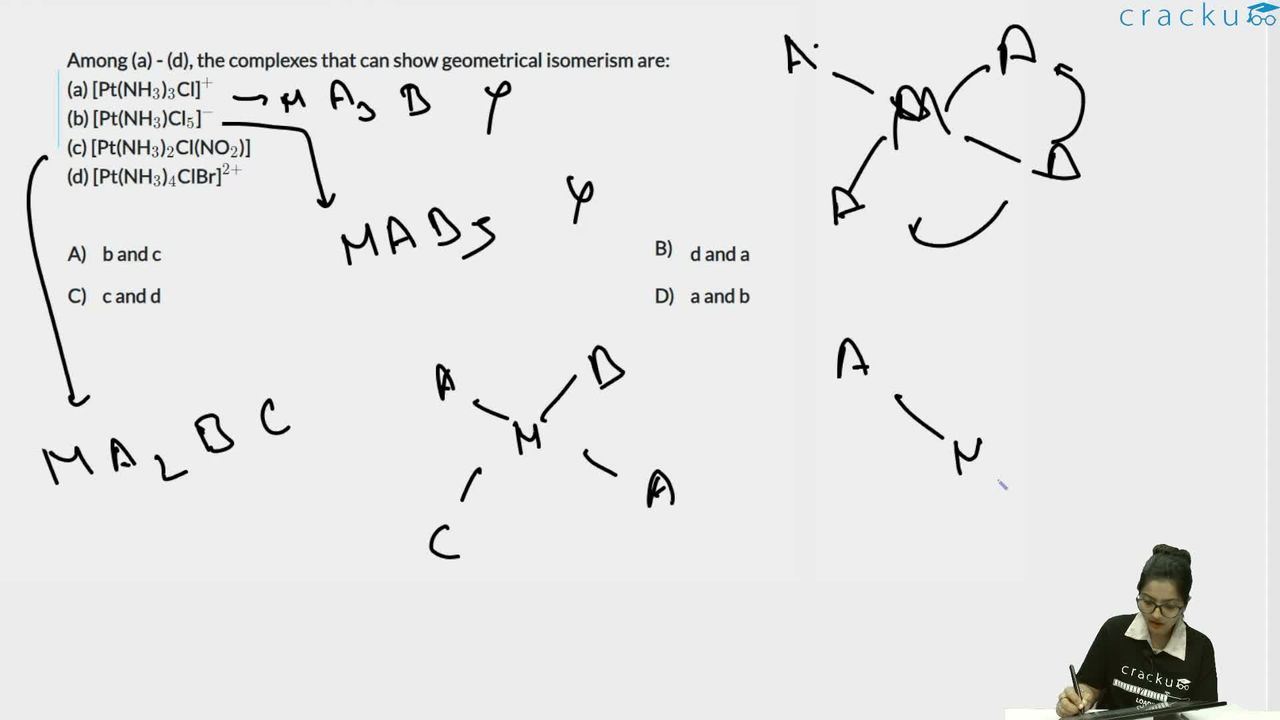
Its empirical type is $$MA_3B$$ where $$A = NH_3$$ and $$B = Cl^-$$.
For a square-planar $$MA_3B$$ ion, placing the single $$B$$ ligand at any one of the four corners and then simply rotating the square makes all arrangements equivalent. Hence there is only one possible arrangement and no cis-trans pair can arise.
So, no geometrical isomerism.
(b) $$[{\rm Pt(NH_3)Cl_5}]^{-}$$
Here we have six ligands in all, so Pt must be $$+4$$ and the geometry is octahedral.
The formulation is $$AB_5$$ with $$A = NH_3$$ and $$B = Cl^-$$.
In an octahedron having five identical ligands and one different ligand, whichever position the single $$A$$ occupies, all five $$B$$ ligands remain equivalent by symmetry; consequently there is still only one possible arrangement.
Thus, no geometrical isomerism can occur.
(c) $$[{\rm Pt(NH_3)_2Cl(NO_2)}]$$
This complex has four ligands, giving a square-planar $$+2$$ species.
Its type is $$MA_2BC$$ with the identical ligands $$A = NH_3$$.
For a square-planar $$MA_2BC$$ complex, the two identical $$A$$ ligands may lie adjacent (cis) or opposite (trans).
Hence two distinct geometrical isomers (cis and trans) are possible.
(d) $$[{\rm Pt(NH_3)_4ClBr}]^{2+}$$
There are six ligands, so again Pt is $$+4$$ and the geometry is octahedral.
The pattern is $$MA_4BC$$ where $$A = NH_3,\; B = Cl^-,\; C = Br^-$$.
In an octahedron of type $$MA_4BC$$ the two different ligands ($$B$$ and $$C$$) can be placed either cis (adjacent) or trans (opposite) to each other, producing two geometrical isomers.
Summarising these results:
$$[{\rm Pt(NH_3)_3Cl}]^{+}$$ - no isomerism;
$$[{\rm Pt(NH_3)Cl_5}]^{-}$$ - no isomerism;
$$[{\rm Pt(NH_3)_2Cl(NO_2)}]$$ - shows geometrical isomerism;
$$[{\rm Pt(NH_3)_4ClBr}]^{2+}$$ - shows geometrical isomerism.
Therefore the complexes capable of geometrical isomerism are (c) and (d).
Hence, the correct answer is Option C.
Was this solution helpful?
Click on the Email ☝️ to Watch the Video Solution
Create a FREE account and get:
_1.webp)

Educational materials for JEE preparation

Ask our AI anything

AI can make mistakes. Please verify important information.
AI can make mistakes. Please verify important information.


