
Join Our JEE Preparation Group
Prep with like-minded aspirants; Get access to free daily tests and study material.
Sign in
Please select an account to continue using cracku.in
↓ →
Join Our JEE Preparation Group
Prep with like-minded aspirants; Get access to free daily tests and study material.
White phosphorus on reaction with concentrated NaOH solution in an inert atmosphere of CO$$_2$$ gives phosphine and compound (X). (X) on acidification with HCl gives compound (Y). The basicity of compound (Y) is:
We have the well-known disproportionation of white phosphorus in strong alkali. When $$\mathrm{P_4}$$ is boiled with concentrated $$\mathrm{NaOH}$$ solution in an atmosphere of $$\mathrm{CO_2}$$ (so that no air oxidation takes place), phosphorus undergoes simultaneous oxidation and reduction. The balanced chemical equation is
$$\mathrm{P_4 + 3\,NaOH + 3\,H_2O \;\longrightarrow\; 3\,NaH_2PO_2 + PH_3}$$
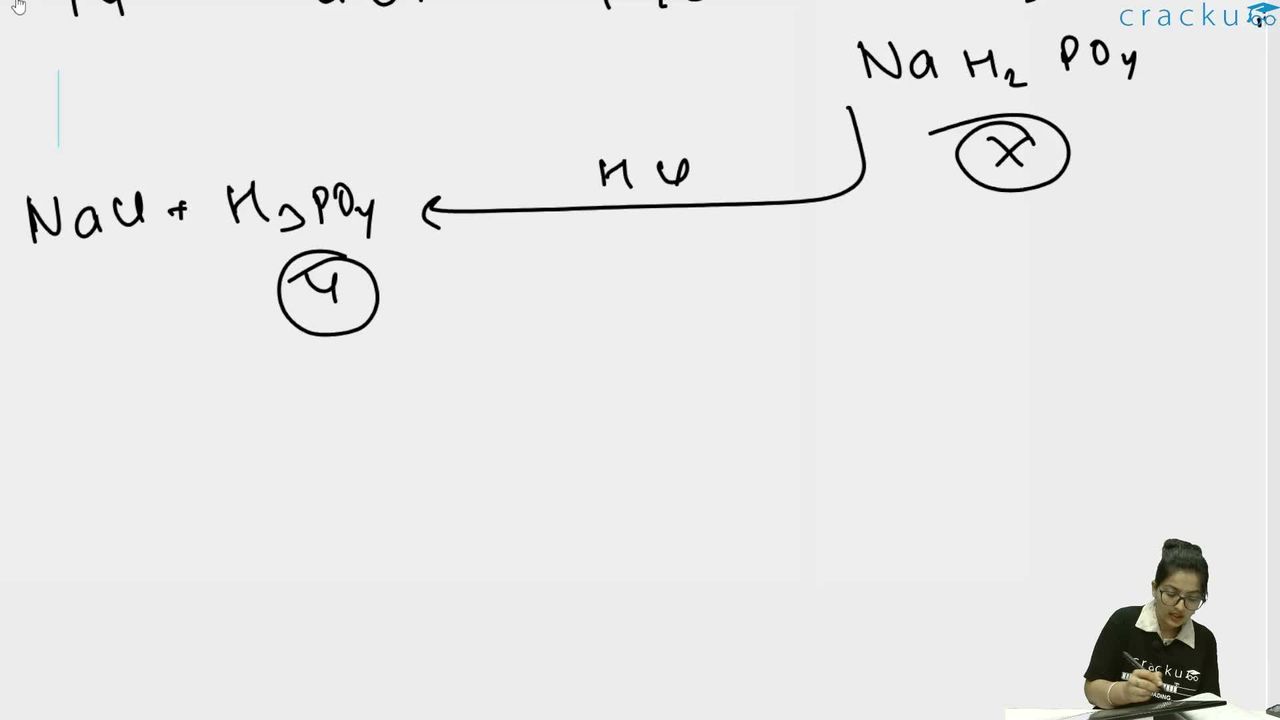
Thus the side product $$\mathrm{PH_3}$$ (phosphine) is obtained together with compound $$(X)=\; \mathrm{NaH_2PO_2}$$, which is called sodium hypophosphite.
Now the statement says that compound $$(X)$$ is acidified with dilute $$\mathrm{HCl}$$. Whenever a salt of an oxy-acid is treated with a strong acid, the corresponding free oxy-acid is liberated. Therefore,
$$\mathrm{NaH_2PO_2 + HCl \;\longrightarrow\; H_3PO_2 + NaCl}$$
So compound $$(Y)$$ formed after acidification is $$\mathbf{H_3PO_2}$$, hypophosphorous acid.
To find its basicity we must look at its actual structure. The valence-bond formula of $$\mathrm{H_3PO_2}$$ is
$$\mathrm{H\!-\!P(=O)(OH)H}$$
Here we notice two different kinds of hydrogen atoms:
• Two hydrogens (shown on the P—H bonds) are attached directly to phosphorus. These hydrogens are not ionisable; they cannot be replaced by metal ions in aqueous solution.
• Only one hydrogen is attached to oxygen in the O-H group. This particular hydrogen is protonic (acidic) and can be given off as $$\mathrm{H^+}$$. Hence just one hydrogen per molecule can be neutralised by base.
By definition, the basicity of an acid is the number of replaceable (ionisable) hydrogens present in one molecule. Since only the single O-H hydrogen is replaceable,
$$\text{Basicity of } \mathrm{H_3PO_2}=1$$
Therefore compound $$(Y)$$ is monobasic.
Comparing with the options, the value $$1$$ corresponds to Option B.
Hence, the correct answer is Option B.
Was this solution helpful?
Click on the Email ☝️ to Watch the Video Solution
Create a FREE account and get:
_1.webp)

Educational materials for JEE preparation

Ask our AI anything

AI can make mistakes. Please verify important information.
AI can make mistakes. Please verify important information.


