
Join Our JEE Preparation Group
Prep with like-minded aspirants; Get access to free daily tests and study material.
Sign in
Please select an account to continue using cracku.in
↓ →
Join Our JEE Preparation Group
Prep with like-minded aspirants; Get access to free daily tests and study material.
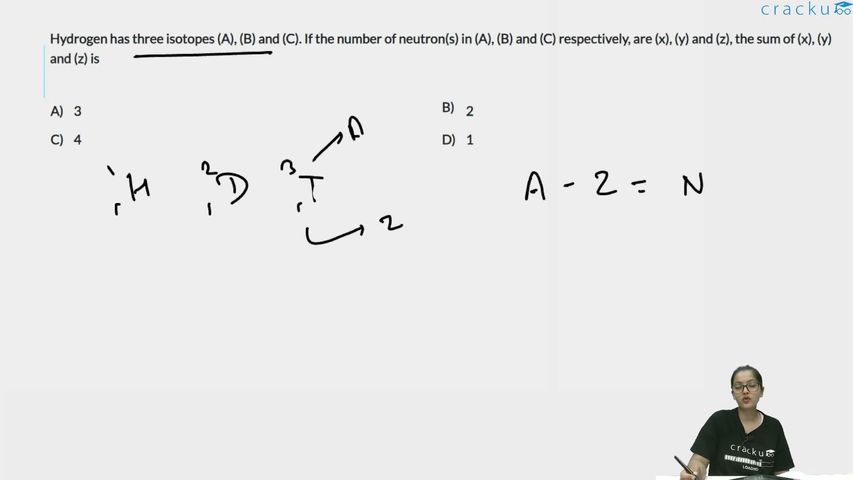
Hydrogen has three isotopes (A), (B) and (C). If the number of neutron(s) in (A), (B) and (C) respectively, are (x), (y) and (z), the sum of (x), (y) and (z) is
For any nucleus, the relation between mass number and the numbers of protons and neutrons is stated first:
$$A \;=\; Z \;+\; N,$$
where $$A$$ is the mass number (total nucleons), $$Z$$ is the atomic number (number of protons) and $$N$$ is the number of neutrons.
In every isotope of hydrogen, the atomic number is the same, $$Z = 1,$$ because each hydrogen atom possesses one proton. The three isotopes differ only in their mass numbers, so we now examine them one by one.
Isotope (A) is protium and has mass number $$A = 1.$$ Substituting in the formula, we have
$$N = A - Z = 1 - 1 = 0.$$ So, $$x = 0.$$
Isotope (B) is deuterium and its mass number is $$A = 2.$$ Again, using the same formula,
$$N = A - Z = 2 - 1 = 1.$$ Hence, $$y = 1.$$
Isotope (C) is tritium with mass number $$A = 3.$$ Applying the formula once more,
$$N = A - Z = 3 - 1 = 2.$$ Therefore, $$z = 2.$$
We now add the three neutron numbers:
$$x + y + z = 0 + 1 + 2 = 3.$$
Thus, the required sum is $$3.$$
Hence, the correct answer is Option A.
Was this solution helpful?
Click on the Email ☝️ to Watch the Video Solution
Create a FREE account and get:
_1.webp)

Educational materials for JEE preparation

Ask our AI anything

AI can make mistakes. Please verify important information.
AI can make mistakes. Please verify important information.


