
Join Our JEE Preparation Group
Prep with like-minded aspirants; Get access to free daily tests and study material.
Sign in
Please select an account to continue using cracku.in
↓ →
Join Our JEE Preparation Group
Prep with like-minded aspirants; Get access to free daily tests and study material.
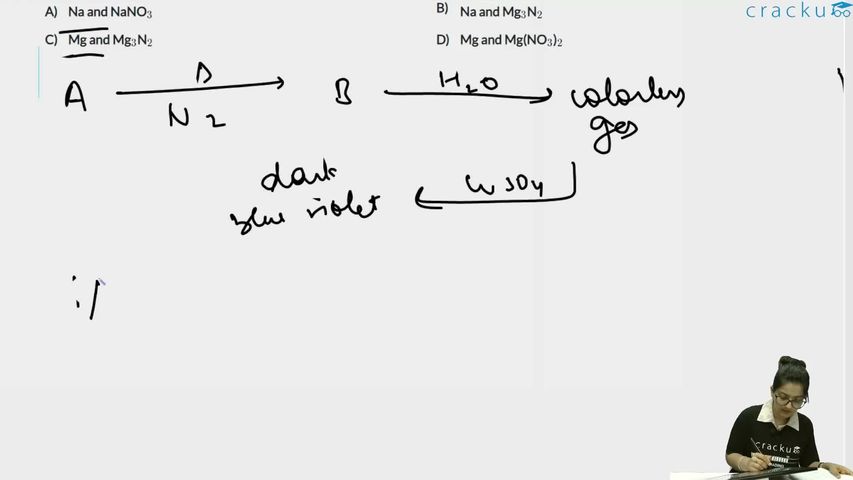
A metal (A) on heating in nitrogen gas gives compound B. B on treatment with H$$_2$$O gives a colourless gas which when passed through CuSO$$_4$$ solution gives a dark blue-violet coloured solution. A and B respectively, are:
We begin with the information that a metal, called $$A$$, is heated in a stream of nitrogen gas and gives a new substance $$B$$. The most common change that occurs when a reactive metal is treated with nitrogen at high temperature is the direct formation of a metal nitride. Symbolically we can write the general reaction first:
$$\text{Metal}\;(A) + N_2 \;\overset{\text{heat}}{\rightarrow}\; \text{Metal nitride}\;(B).$$
Now we look at the four options for $$A$$ and $$B$$:
Option A: $$A = \text{Na},\; B = \text{NaNO}_3$$ Option B: $$A = \text{Na},\; B = \text{Mg}_3N_2$$ Option C: $$A = \text{Mg},\; B = \text{Mg}_3N_2$$ Option D: $$A = \text{Mg},\; B = \text{Mg(NO}_3)_2$$
Sodium metal does not readily combine with nitrogen at ordinary or even moderately high temperatures; instead, it burns in air to give oxides or peroxides. Magnesium, on the other hand, is well known to react directly with nitrogen at red heat to give magnesium nitride. Hence the only chemically reasonable nitride among the four possibilities is the pair
$$A = \text{Mg}, \quad B = \text{Mg}_3N_2.$$
So at this stage we favour Option C, but we must verify the rest of the data. Let us pursue the subsequent steps.
The problem states that compound $$B$$ is treated with water and produces a colourless gas. We write the stoichiometric equation for the hydrolysis of magnesium nitride:
$$\text{(Formula)} \qquad Mg_3N_2 + 6H_2O \;\longrightarrow\; 3Mg(OH)_2 + 2NH_3.$$
In words, magnesium nitride reacts with water to give magnesium hydroxide and ammonia. Ammonia $$(NH_3)$$ is indeed a colourless gas with a pungent smell.
Next, the produced gas is bubbled through an aqueous copper(II) sulfate solution. We recall a standard qualitative test: ammonia forms a deep blue-violet (often simply called “deep blue”) complex with $${Cu}^{2+}$$ ions, namely the tetrammine copper(II) ion $$[Cu(NH_3)_4]^{2+}$$. The formation of this soluble complex causes the light blue $$CuSO_4$$ solution to change to a characteristic dark blue-violet colour. In equation form, the key step is
$$Cu^{2+}_{(aq)} + 4NH_{3\,(aq)} \;\longrightarrow\; [Cu(NH_3)_4]^{2+}_{(aq)}$$
with the accompanying colour change exactly as described in the question. Therefore the colour test fully supports that the evolved gas is indeed ammonia.
Because ammonia is only produced when a nitride such as $$Mg_3N_2$$ is hydrolysed, and because magnesium is the metal that combines with nitrogen to give that nitride, the only self-consistent pair among the choices is
$$A = Mg, \qquad B = Mg_3N_2.$$
Hence, the correct answer is Option C.
Was this solution helpful?
Click on the Email ☝️ to Watch the Video Solution
Create a FREE account and get:
_1.webp)

Educational materials for JEE preparation

Ask our AI anything

AI can make mistakes. Please verify important information.
AI can make mistakes. Please verify important information.


