Join Our JEE Preparation Group
Prep with like-minded aspirants; Get access to free daily tests and study material.
Sign in
Please select an account to continue using cracku.in
↓ →
Join Our JEE Preparation Group
Prep with like-minded aspirants; Get access to free daily tests and study material.
Key Concept: Organic compounds are broadly classified based on their carbon skeletons. Aliphatic compounds include both open-chain (acyclic) compounds and cyclic systems that mimic open-chain behavior (alicyclic). Cyclic compounds containing alternate single and double bonds that follow Hückel's rule are classified as aromatic.
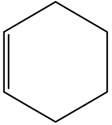
Option [A]: Benzenoid aromatic. Benzenoid aromatic compounds contain at least one benzene ring ($$C_6H_6$$) structure characterized by alternating single and double bonds with a fully delocalized ring system of $$6\pi$$ electrons. Cyclohexene ($$C_6H_{10}$$) contains only one double bond and lacks a fully delocalized conjugated aromatic system. This is FALSE.
Option [B]: Benzenoid non-aromatic. The term benzenoid is explicitly reserved for structures containing benzene rings. Since cyclohexene does not feature a benzene ring network, it cannot be described as benzenoid. This is FALSE.
Option [C]: Acyclic. Acyclic compounds are open-chain organic compounds that do not contain any ring structure in their carbon backbone. Cyclohexene contains a closed six-membered carbon ring. This is FALSE.
Option [D]: Alicyclic. Alicyclic compounds (aliphatic cyclic) are organic compounds that are both aliphatic and cyclic. They contain one or more closed carbon rings, which can be saturated or unsaturated (containing double or triple bonds), but they do not possess aromatic character. Cyclohexene consists of a cyclic ring with one carbon-carbon double bond, matching this classification perfectly. This is TRUE.
Therefore, cyclohexene is classified as an alicyclic organic compound.
Answer: Option D — Alicyclic
Was this solution helpful?
Create a FREE account and get:
_1.webp)

Educational materials for JEE preparation

Ask our AI anything

AI can make mistakes. Please verify important information.
AI can make mistakes. Please verify important information.