
Join Our JEE Preparation Group
Prep with like-minded aspirants; Get access to free daily tests and study material.
Sign in
Please select an account to continue using cracku.in
↓ →
Join Our JEE Preparation Group
Prep with like-minded aspirants; Get access to free daily tests and study material.
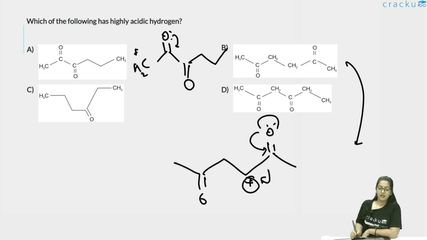
The acidity of a hydrogen atom depends on the stability of the conjugate base formed after its removal. Greater stabilization of the resulting carbanion leads to higher acidity.
In the alpha-diketone and gamma-diketone structures, the acidic hydrogens are influenced by only one carbonyl group at a time or are too far from the second carbonyl group to experience significant stabilization.
In the monoketone, the alpha hydrogen is stabilized by resonance with only a single carbonyl group. Therefore, its acidity is moderate and comparable to that of ordinary ketones.
In the beta-diketone structure, the central $$-CH_2-$$ group is located between two carbonyl groups. When a proton is removed from this carbon, the resulting negative charge is delocalized through resonance over both adjacent carbonyl groups.
This extensive resonance stabilization distributes the negative charge onto both oxygen atoms, making the conjugate base exceptionally stable. The combined electron-withdrawing effect of the two carbonyl groups greatly enhances the acidity of the central methylene hydrogens.
Therefore, the hydrogen atoms of the active methylene group present in the beta-diketone are the most acidic among the given compounds.
Hence, the correct answer is, $$\text{The }\beta\text{-diketone compound (Option D)}$$
Was this solution helpful?
Click on the Email ☝️ to Watch the Video Solution
Create a FREE account and get:
_1.webp)

Educational materials for JEE preparation

Ask our AI anything

AI can make mistakes. Please verify important information.
AI can make mistakes. Please verify important information.
