
Join Our JEE Preparation Group
Prep with like-minded aspirants; Get access to free daily tests and study material.
Sign in
Please select an account to continue using cracku.in
↓ →
Join Our JEE Preparation Group
Prep with like-minded aspirants; Get access to free daily tests and study material.
Lower $$\mathrm{pK_a}$$ value indicates higher acidity.
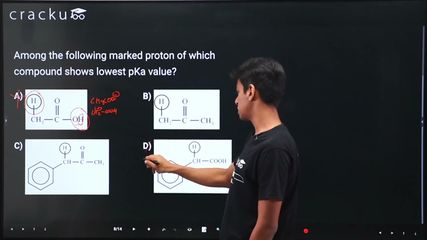
Options $$\mathrm{A}$$ and $$\mathrm{B}$$ can be eliminated because the conjugate bases formed from options $$\mathrm{C}$$ and $$\mathrm{D}$$ are additionally stabilised by resonance due to their benzylic positions adjacent to carbonyl groups.
In option $$\mathrm{C}$$, the highlighted $$\mathrm{\alpha}$$-hydrogen is adjacent to a ketone group.
On removal of this proton, the resulting carbanion is strongly stabilised by resonance with the carbonyl group.
$$\mathrm{R-CO-CH_2^- \rightleftharpoons R-C(O^-)=CH_2}$$
The ketone carbonyl exerts a strong electron-withdrawing:
$$\mathrm{-M\ effect}$$
thereby stabilising the conjugate base.
In option $$\mathrm{D}$$, the highlighted hydrogen is adjacent to a carboxylic acid group:
$$\mathrm{(-COOH)}$$
The $$\mathrm{-OH}$$ group donates electron density through resonance:
$$\mathrm{+M\ effect}$$
which reduces the electron-withdrawing nature of the carbonyl group.
Hence, the carboxylic acid carbonyl stabilises the adjacent carbanion less effectively than the ketone in option $$\mathrm{C}$$.
Also, the carboxylic acid possesses a highly acidic $$\mathrm{O-H}$$ proton.
A base preferentially removes this proton first:
$$\mathrm{R-COOH + Base \longrightarrow R-COO^-}$$
Further removal of the highlighted $$\mathrm{C-H}$$ proton would generate a dianion, which is highly unstable.
Therefore, abstraction of the highlighted proton in option $$\mathrm{D}$$ is thermodynamically unfavourable.
Hence, the most acidic highlighted hydrogen is present in:
$$\boxed{\mathrm{Option\ C}}$$
Click on the Email ☝️ to Watch the Video Solution
Create a FREE account and get:
_1.webp)

Educational materials for JEE preparation

Ask our AI anything

AI can make mistakes. Please verify important information.
AI can make mistakes. Please verify important information.


