
Join Our JEE Preparation Group
Prep with like-minded aspirants; Get access to free daily tests and study material.
Sign in
Please select an account to continue using cracku.in
↓ →
Join Our JEE Preparation Group
Prep with like-minded aspirants; Get access to free daily tests and study material.
Match List-I with List-II.
| List-I | List-II |
|---|---|
A
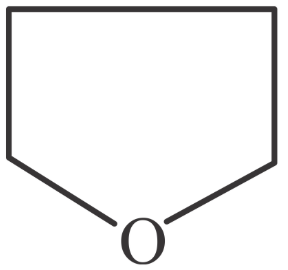 | I. Spiro compound |
B
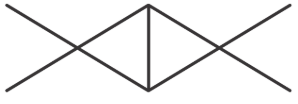 | II. Aromatic compound |
C
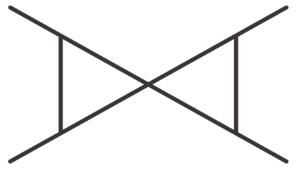 | III. Non-planar Heterocyclic compound |
D
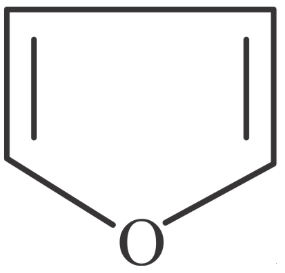 | IV. Bicyclo compound |
Structure $$\mathrm{A}$$ represents tetrahydrofuran, a saturated five-membered ring containing an oxygen atom.
Since the ring contains an atom other than carbon, it is a heterocyclic compound.
All carbon atoms are $$\mathrm{sp^3}$$ hybridised, so the ring adopts a puckered non-planar geometry to minimise ring strain.
Therefore:
$$\mathrm{A \rightarrow III}$$
$$\mathrm{(Non\text{-}planar\ Heterocyclic\ Compound)}$$
Structure $$\mathrm{B}$$ contains two triangular rings sharing a common bond.
Thus, the two rings share two adjacent carbon atoms.
Compounds in which rings share two or more atoms are called bicyclo compounds.
Therefore:
$$\mathrm{B \rightarrow IV}$$
$$\mathrm{(Bicyclo\ Compound)}$$
Structure $$\mathrm{C}$$ contains two rings joined through exactly one common carbon atom.
Such compounds are called spiro compounds.
Therefore:
$$\mathrm{C \rightarrow I}$$
$$\mathrm{(Spiro\ Compound)}$$
Structure $$\mathrm{D}$$ represents furan.
It is cyclic, planar and fully conjugated.
One lone pair of oxygen participates in delocalisation, giving:
$$\mathrm{6\ \pi\ electrons}$$
Thus, it satisfies Hückel’s rule:
$$\mathrm{(4n+2)\ \pi\ electrons}$$
Hence, furan is aromatic.
Therefore:
$$\mathrm{D \rightarrow II}$$
$$\mathrm{(Aromatic\ Compound)}$$
Correct matching:
$$\boxed{\mathrm{A-III,\ B-IV,\ C-I,\ D-II}}$$
Create a FREE account and get:
_1.webp)

Educational materials for JEE preparation

Ask our AI anything

AI can make mistakes. Please verify important information.
AI can make mistakes. Please verify important information.


