Join Our JEE Preparation Group
Prep with like-minded aspirants; Get access to free daily tests and study material.
Sign in
Please select an account to continue using cracku.in
↓ →
Join Our JEE Preparation Group
Prep with like-minded aspirants; Get access to free daily tests and study material.
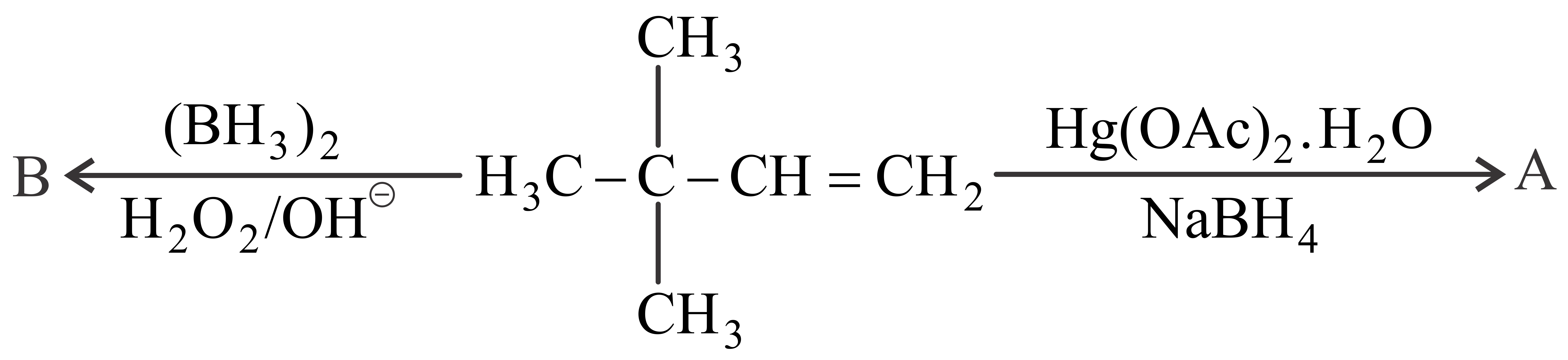
The starting alkene is:
$$\mathrm{3,3\text{-}dimethylbut\text{-}1\text{-}ene}$$
For formation of product $$\mathrm{A}$$, the reagents used are:
$$\mathrm{Hg(OAc)_2 \cdot H_2O \ followed\ by\ NaBH_4}$$
This reaction is:
$$\mathrm{Oxymercuration\text{-}Demercuration}$$
The reaction proceeds through a mercurinium ion intermediate and does not involve carbocation rearrangement.
Water attacks the more substituted carbon of the double bond.
Hence, the hydroxyl group attaches according to:
$$\mathrm{Markovnikov\ addition}$$
Therefore, product $$\mathrm{A}$$ is a Markovnikov product.
For formation of product $$\mathrm{B}$$, the reagents used are:
$$\mathrm{(BH_3)_2 \ followed\ by\ H_2O_2/OH^-}$$
This reaction is:
$$\mathrm{Hydroboration\text{-}Oxidation}$$
Boron attaches to the less substituted carbon due to steric and electronic factors.
During oxidation, boron is replaced by:
$$\mathrm{-OH}$$
Thus, the hydroxyl group finally appears on the less substituted carbon.
Hence, hydration occurs through:
$$\mathrm{Anti\text{-}Markovnikov\ addition}$$
Therefore, product $$\mathrm{B}$$ is an anti-Markovnikov product.
Thus:
$$\mathrm{A = Markovnikov\ Product}$$
$$\mathrm{B = Anti\text{-}Markovnikov\ Product}$$
Was this solution helpful?
Create a FREE account and get:
_1.webp)

Educational materials for JEE preparation

Ask our AI anything

AI can make mistakes. Please verify important information.
AI can make mistakes. Please verify important information.