
Join Our JEE Preparation Group
Prep with like-minded aspirants; Get access to free daily tests and study material.
Sign in
Please select an account to continue using cracku.in
↓ →
Join Our JEE Preparation Group
Prep with like-minded aspirants; Get access to free daily tests and study material.
Which of the following transitions in hydrogen atoms emit photons of highest frequency?
The energy of an electron in the $$n^{\text{th}}$$ Bohr orbit of a hydrogen atom is given by
$$E_n = -\frac{13.6\ \text{eV}}{n^{2}}$$
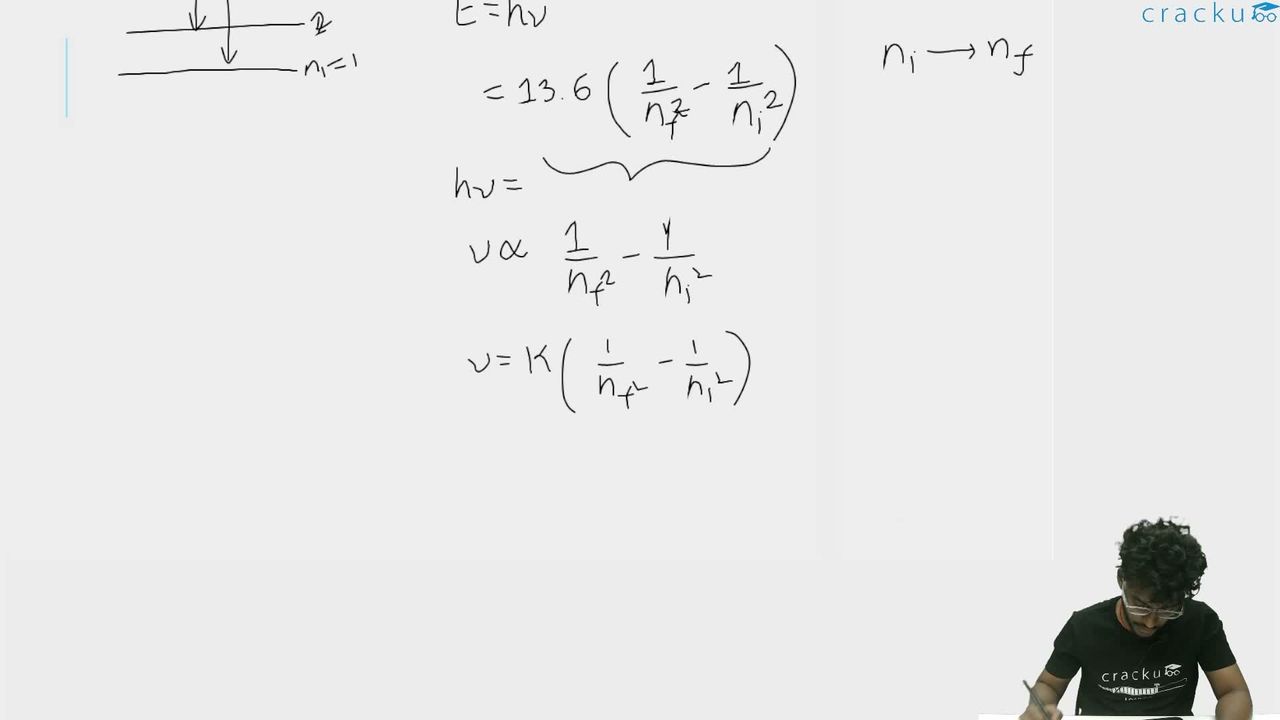
When the electron drops from a higher orbit $$n_i$$ to a lower orbit $$n_f$$, the energy released as a photon is
$$\Delta E = E_{n_f} - E_{n_i} = -\frac{13.6}{n_f^{2}} - \left(-\frac{13.6}{n_i^{2}}\right) = 13.6\left(\frac{1}{n_f^{2}} - \frac{1}{n_i^{2}}\right)\ (\text{eV})$$
Frequency of the emitted photon is related to this energy by $$\Delta E = h\nu \; \Longrightarrow \; \nu = \dfrac{\Delta E}{h}$$. Hence, the larger the magnitude of $$\Delta E$$, the higher the frequency $$\nu$$.
Case 1: $$n_i = 2 \rightarrow n_f = 6$$ (actually an upward jump, so this is absorption, not emission). Discard.
Case 2: $$n_i = 6 \rightarrow n_f = 2$$ (emission)
$$\Delta E = 13.6\left(\frac{1}{2^{2}} - \frac{1}{6^{2}}\right) = 13.6\left(\frac{1}{4} - \frac{1}{36}\right) = 13.6\left(\frac{9-1}{36}\right) = 13.6 \times \frac{8}{36} \approx 3.02\ \text{eV}$$
Case 3: $$n_i = 2 \rightarrow n_f = 1$$ (emission)
$$\Delta E = 13.6\left(\frac{1}{1^{2}} - \frac{1}{2^{2}}\right) = 13.6\left(1 - \frac{1}{4}\right) = 13.6 \times \frac{3}{4} = 10.2\ \text{eV}$$
Case 4: $$n_i = 1 \rightarrow n_f = 2$$ (upward jump, absorption). Discard.
Among the two genuine emission cases, Case 3 releases $$10.2\ \text{eV}$$ while Case 2 releases only $$3.02\ \text{eV}$$. Since frequency is directly proportional to emitted energy ($$\nu = \Delta E/h$$), the transition $$n = 2 \rightarrow n = 1$$ produces photons of the highest frequency.
Option C which is: $$n = 2$$ to $$n = 1$$
Was this solution helpful?
Click on the Email ☝️ to Watch the Video Solution
Create a FREE account and get:
_1.webp)

Educational materials for JEE preparation

Ask our AI anything

AI can make mistakes. Please verify important information.
AI can make mistakes. Please verify important information.
