
Join Our JEE Preparation Group
Prep with like-minded aspirants; Get access to free daily tests and study material.
Sign in
Please select an account to continue using cracku.in
↓ →
Join Our JEE Preparation Group
Prep with like-minded aspirants; Get access to free daily tests and study material.
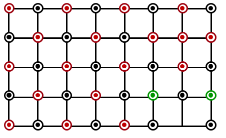
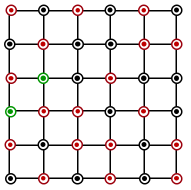
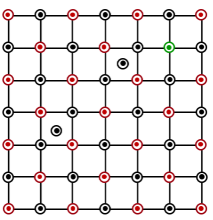
Which of the following represents the lattice structure of $$A_{0.95}O$$ containing $$A^{2+}, A^{3+}$$ and $$O^{2-}$$ ions

(A)
(B)
(c)
The stoichiometric oxide of a divalent metal has the formula $$AO$$, so the lattice contains equal numbers of cation and anion sites.
The given compound is $$A_{0.95}O$$.
Hence, per one $$O^{2-}$$ ion there are only $$0.95$$ cations present; the remaining $$0.05$$ cation sites are vacant.
Because the lattice also contains some $$A^{3+}$$ ions, overall electrical neutrality must be satisfied:
Let $$x$$ be the fraction of the cations that are $$A^{3+}$$ and $$(0.95 - x)$$ the fraction that are $$A^{2+}$$.
Charge balance condition:
$$3x + 2(0.95 - x) = 2\quad -(1)$$
Solving $$-(1)$$ gives
$$3x + 1.9 - 2x = 2 \implies x = 0.1$$.
Therefore (per $$O^{2-}$$ ion) we have
$$0.10$$ ions of $$A^{3+}$$, $$0.85$$ ions of $$A^{2+}$$ and $$0.05$$ vacant cation sites.
Expressed with a convenient integer basis, multiply by 20 (so that the vacancy count is a whole number):
Number of $$O^{2-}$$ ions = 20
Number of $$A^{3+}$$ ions = $$0.10 \times 20 = 2$$
Number of $$A^{2+}$$ ions = $$0.85 \times 20 = 17$$
Number of vacant cation sites = $$0.05 \times 20 = 1$$.
Thus a correct lattice diagram must display (for every 20 oxide ions) 19 cations of which 2 carry +3 charge, 17 carry +2 charge, and exactly 1 cation site is empty.
Examination of the three diagrams supplied in the question shows:
Case A:Only diagram A fulfils both the stoichiometric requirement (cation deficiency of 5 %) and the charge-neutral distribution of $$A^{2+}$$ and $$A^{3+}$$ ions.
Hence the correct choice is
Option A which is: A only.
Was this solution helpful?
_1.webp)

Educational materials for JEE preparation

Ask our AI anything

AI can make mistakes. Please verify important information.
AI can make mistakes. Please verify important information.