Join Our JEE Preparation Group
Prep with like-minded aspirants; Get access to free daily tests and study material.
Sign in
Please select an account to continue using cracku.in
↓ →
Join Our JEE Preparation Group
Prep with like-minded aspirants; Get access to free daily tests and study material.
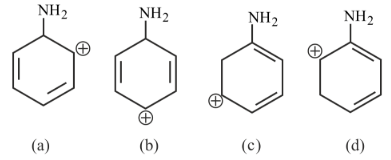
To decide which of the four carbocations (labelled a, b, c, d) is the most stable, compare them on the two main factors that control carbocation stability:
(i) Degree of alkyl substitution (hyperconjugation):
$$\text{tertiary} \gt \text{secondary} \gt \text{primary} \gt \text{methyl}$$
(ii) Resonance delocalisation: A carbocation that can delocalise its positive charge over several atoms (e.g. benzylic or allylic positions) is far more stable than one that cannot.
Step-by-step comparison of the given cations:
Case a: a simple tertiary aliphatic carbocation. Stabilised only by hyperconjugation; no resonance possible.
Case b: a secondary benzylic carbocation. The positive charge is delocalised into the benzene ring (resonance), but because it is only secondary there are fewer hyperconjugative structures than in a tertiary system.
Case c: a tertiary benzylic carbocation. It enjoys both advantages simultaneously—maximum hyperconjugation (three alkyl groups) and extensive resonance with the aromatic ring (five additional resonance forms). This joint stabilisation makes it exceptionally stable.
Case d: an allylic carbocation. Although resonance-stabilised over an allylic system, it lacks the large number of hyperconjugative structures found in a tertiary benzylic cation.
Ordering the four on the combined criteria:
tertiary benzylic (c) > secondary benzylic (b) > tertiary aliphatic (a) > allylic (d)
Hence the most stable carbocation among the options is the one labelled c.
Option A which is: c
Was this solution helpful?
Create a FREE account and get:
_1.webp)

Educational materials for JEE preparation

Ask our AI anything

AI can make mistakes. Please verify important information.
AI can make mistakes. Please verify important information.