Join WhatsApp Icon JEE WhatsApp Group
Question 37

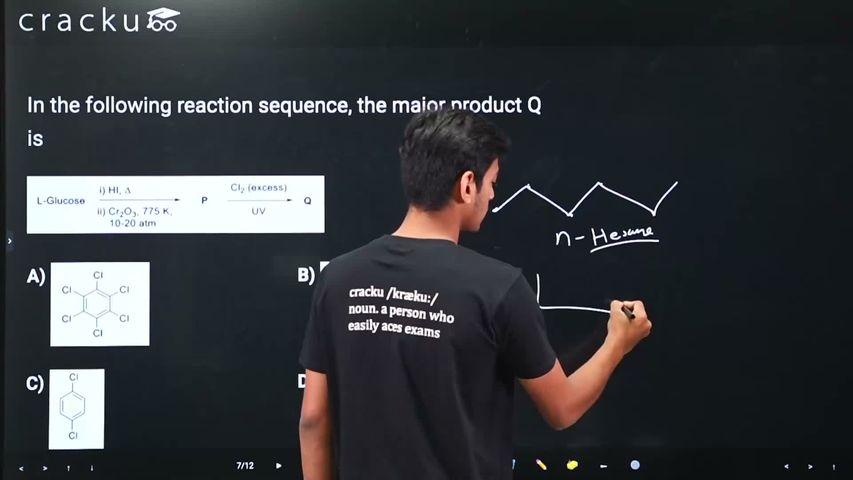
In the following reaction sequence, the major product Q is

image

1. Formation of Intermediate P

Step i: Reaction of L-Glucose with HI and Heat (Δ)

  • What happens: Prolonged heating of glucose (whether D-glucose or L-glucose) with hydroiodic acid (HI) reduces all the hydroxyl (-OH) groups and the carbonyl group.
  • Result: This converts the 6-carbon sugar chain into a straight-chain alkane.
  • Intermediate formed: n-hexane (CH₃-CH₂-CH₂-CH₂-CH₂-CH₃)

Step ii: Aromatization using Cr₂O₃, 775 K, 10-20 atm

  • What happens: When n-hexane is heated with a chromium oxide (Cr₂O₃) catalyst at high temperatures and pressures, it undergoes cyclization and dehydrogenation (aromatization).
  • Product P: Benzene (C₆H₆)

2. Formation of Final Product Q

Reaction of Benzene (P) with Excess Cl₂ in the presence of UV light

  • What happens: When benzene is treated with excess chlorine gas (Cl₂) under ultraviolet (UV) light or sunlight, it undergoes a free-radical addition reaction across the aromatic double bonds.
  • Key Detail: This is an addition reaction, not an electrophilic substitution reaction, because UV light breaks down Cl₂ into chlorine radicals. Each of the 3 double bonds in the benzene ring adds two chlorine atoms.
  • Chemical Equation: C₆H₆ + 3 Cl₂ (in the presence of UV) ⟶ C₆H₆Cl₆

Get AI Help

Video Solution

video

Create a FREE account and get:

  • Free JEE Advanced Previous Papers PDF
  • Take JEE Advanced paper tests
Ask AI