
Join Our JEE Preparation Group
Prep with like-minded aspirants; Get access to free daily tests and study material.
Sign in
Please select an account to continue using cracku.in
↓ →
Join Our JEE Preparation Group
Prep with like-minded aspirants; Get access to free daily tests and study material.
In a metal deficient oxide sample, $$M_XY_2O_4$$ (M and Y are metals), M is present in both +2 and +3 oxidation states and Y is in +3 oxidation state. If the fraction of $$M^{2+}$$ ions present in M is $$\frac{1}{3}$$, the value of X is ______.
Let the empirical formula of the oxide be $$M_xY_2O_4$$, where $$x$$ moles of metal $$M$$ are present per formula unit.
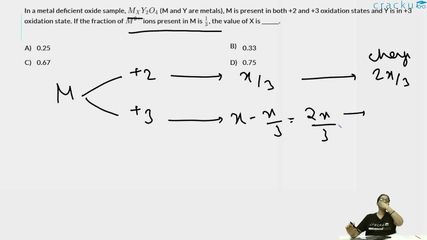
M exists in two oxidation states: $$+2$$ and $$+3$$.
Given fraction of $$M^{2+}$$ ions = $$\dfrac{1}{3}$$.
Therefore, fraction of $$M^{3+}$$ ions = $$1 - \dfrac{1}{3} = \dfrac{2}{3}$$.
Total number of $$M$$ ions = $$x$$.
Number of $$M^{2+}$$ ions = $$\dfrac{1}{3}x$$.
Number of $$M^{3+}$$ ions = $$\dfrac{2}{3}x$$.
Calculate the positive charge contributed by each metal:
Charge from $$M^{2+}$$ ions:
$$\left(\dfrac{1}{3}x\right)\times(+2)=\dfrac{2x}{3}$$
Charge from $$M^{3+}$$ ions:
$$\left(\dfrac{2}{3}x\right)\times(+3)=\dfrac{6x}{3}=2x$$
Total positive charge from $$M$$ ions:
$$\dfrac{2x}{3}+2x=\dfrac{8x}{3}$$
Metal $$Y$$ is only in the $$+3$$ state and its subscript is 2, so
Charge from $$Y$$ ions = $$2\times(+3)=+6$$.
Oxygen is in the $$-2$$ state.
Charge from oxygen = $$4\times(-2)=-8$$.
For overall electrical neutrality, the sum of all charges must be zero:
$$\dfrac{8x}{3}+6-8=0$$
Simplify:
$$\dfrac{8x}{3}-2=0 \; \Longrightarrow \; \dfrac{8x}{3}=2 \; \Longrightarrow \; x=\dfrac{2\times3}{8}=0.75$$
Hence, $$X = 0.75$$.
Option D which is: 0.75
Was this solution helpful?
Click on the Email ☝️ to Watch the Video Solution
Create a FREE account and get:
_1.webp)

Educational materials for JEE preparation

Ask our AI anything

AI can make mistakes. Please verify important information.
AI can make mistakes. Please verify important information.
