
Join Our JEE Preparation Group
Prep with like-minded aspirants; Get access to free daily tests and study material.
Sign in
Please select an account to continue using cracku.in
↓ →
Join Our JEE Preparation Group
Prep with like-minded aspirants; Get access to free daily tests and study material.
On the basis of the following thermochemical data: $$\left(\Delta_f G° H^+_{(aq)} = 0\right)$$ $$$H_2O(\ell) \to H^+(aq) + OH^-(aq); \Delta H = 57.32 \text{ kJ}$$$ $$$H_2(g) + \frac{1}{2}O_2(g) \to H_2O(\ell); \Delta H = -286.20 \text{ kJ}$$$ The value of enthalpy of formation of $$OH^-$$ ion at $$25°C$$ is:
We need $$\Delta_f H^\circ (OH^-_{(aq)})$$ at $$25^\circ\text{C}$$. Write the standard enthalpy change of reaction 1 in terms of heats of formation:
Reaction 1: $$H_2O(\ell) \rightarrow H^+_{(aq)} + OH^-_{(aq)}$$ has
$$\Delta H_1^\circ = \Delta_f H^\circ(H^+_{(aq)}) + \Delta_f H^\circ(OH^-_{(aq)}) - \Delta_f H^\circ(H_2O(\ell))$$
Given conventions and data:
$$\Delta_f H^\circ(H^+_{(aq)}) = 0$$ (by convention)
$$\Delta H_1^\circ = +57.32 \text{ kJ mol}^{-1}$$
$$\Delta_f H^\circ(H_2O(\ell))$$ is provided by reaction 2.
Reaction 2 gives the formation of liquid water from the elements:
$$H_2(g) + \frac12 O_2(g) \rightarrow H_2O(\ell); \quad \Delta H_2^\circ = -286.20 \text{ kJ mol}^{-1}$$
Hence, $$\Delta_f H^\circ(H_2O(\ell)) = -286.20 \text{ kJ mol}^{-1}$$.
Substitute these values into the Hess’s law relation:
$$57.32 = 0 + \Delta_f H^\circ(OH^-_{(aq)}) - (-286.20)$$
Solve for $$\Delta_f H^\circ(OH^-_{(aq)})$$:
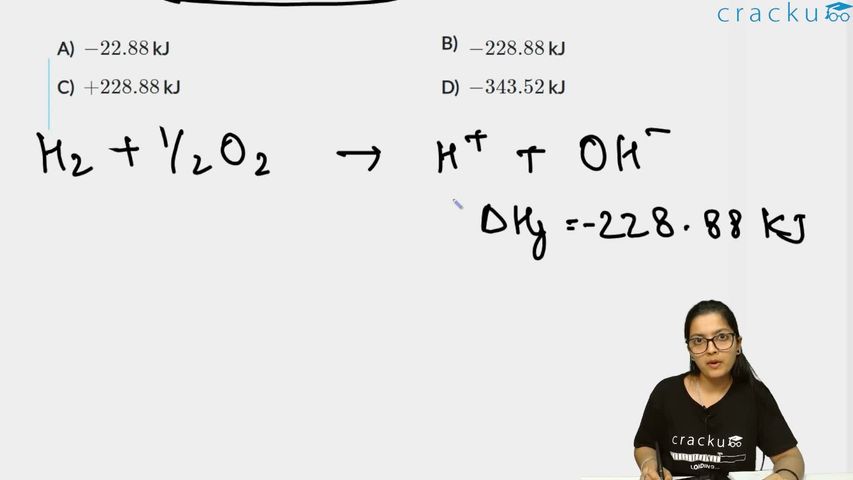
$$\Delta_f H^\circ(OH^-_{(aq)}) = 57.32 - 286.20 = -228.88 \text{ kJ mol}^{-1}$$.
Therefore, the standard enthalpy of formation of the hydroxide ion is $$-228.88 \text{ kJ mol}^{-1}$$.
Option B which is: $$-228.88$$ kJ
Was this solution helpful?
Click on the Email ☝️ to Watch the Video Solution
Create a FREE account and get:
_1.webp)

Educational materials for JEE preparation

Ask our AI anything

AI can make mistakes. Please verify important information.
AI can make mistakes. Please verify important information.
