
Join Our JEE Preparation Group
Prep with like-minded aspirants; Get access to free daily tests and study material.
Sign in
Please select an account to continue using cracku.in
↓ →
Join Our JEE Preparation Group
Prep with like-minded aspirants; Get access to free daily tests and study material.
Covalent character in an ionic compound is predicted with the help of Fajan’s rules.
Fajan’s rules (qualitative form):
1. Greater the charge on the cation, greater is its polarising power ⇒ larger covalent character.
2. Smaller the size (ionic radius) of the cation, greater its polarising power.
3. Larger the size of the anion, easier it gets polarised.
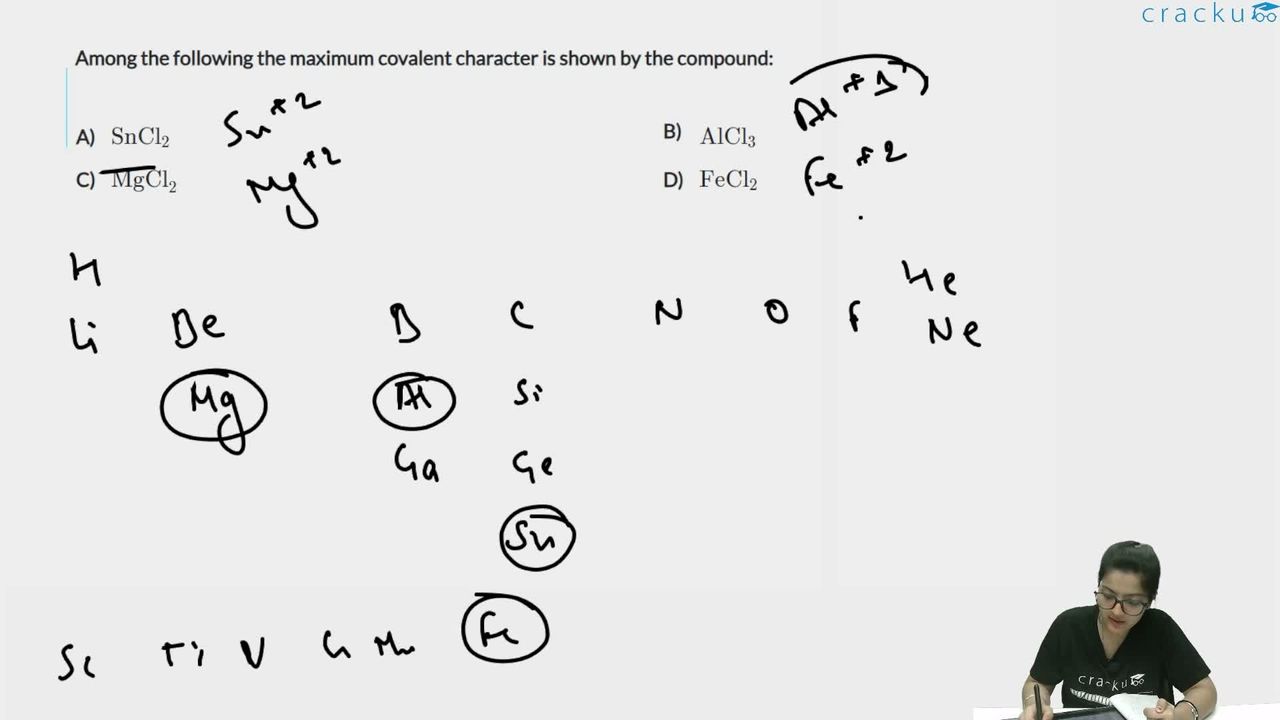
Because the anion is the same in all the given chlorides (Cl−), the trend will be governed almost completely by the nature of the cation.
Compare the four cations present:
• $$\text{Sn}^{2+}$$ : charge = +2, atomic/ionic radius is quite large (p-block, 5th period).
• $$\text{Al}^{3+}$$ : charge = +3, very small ionic radius (p-block, 3rd period).
• $$\text{Mg}^{2+}$$ : charge = +2, somewhat larger than Al but smaller than Sn (s-block, 3rd period).
• $$\text{Fe}^{2+}$$ : charge = +2, transition metal, radius comparable to Mg but has d-electrons that expand the radius slightly.
Key observations:
1. Charge factor: $$\text{Al}^{3+}$$ is the only +3 cation; others are only +2. A higher positive charge strongly increases polarising power.
2. Size factor: $$\text{Al}^{3+}$$ is also the smallest of the four cations (3rd-period element losing three electrons).
3. Combining both factors, $$\text{Al}^{3+}$$ has maximum charge density (charge/volume), giving it the highest ability to polarise the electron cloud of the Cl− ion and impart covalent character to the Al-Cl bond.
The other cations either have lower charge (Sn²+, Mg²+, Fe²+) or larger radii, so their polarising power—and hence the covalent character of their chlorides—is lower.
Therefore, the chloride with the maximum covalent character is $$\text{AlCl}_3$$.
Option B which is: $$\text{AlCl}_3$$
Was this solution helpful?
Click on the Email ☝️ to Watch the Video Solution
Create a FREE account and get:
_1.webp)

Educational materials for JEE preparation

Ask our AI anything

AI can make mistakes. Please verify important information.
AI can make mistakes. Please verify important information.


