
Join Our JEE Preparation Group
Prep with like-minded aspirants; Get access to free daily tests and study material.
Sign in
Please select an account to continue using cracku.in
↓ →
Join Our JEE Preparation Group
Prep with like-minded aspirants; Get access to free daily tests and study material.
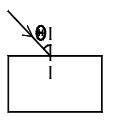
Calcite has the interesting property of splitting a ray of light incident on it in to what are known as ordinary and extraordinary rays. That is, it has two different refractive indices. If the velocity for ordinary ray is $$c_1$$ and that for extraordinary ray is $$c_2$$, find the angle between them after first and second refractions as the light is incident on a slab made of such material at an angle $$\theta$$. Write the expressions, which lead you to the solutions. You need not solve the equations.
Correct Answer: 0
The refractive indices are $$n_1 = \frac{c}{c_1}$$ and $$n_2 = \frac{c}{c_2}$$. At the first face Snell's law gives $$\sin \theta = n_1 \sin r_1 = n_2 \sin r_2$$, so $$\sin r_1 = \frac{c_1 \sin \theta}{c}$$ and $$\sin r_2 = \frac{c_2 \sin \theta}{c}$$, and inside the slab the angle between the two rays is $$|r_1 - r_2|$$. At the second (parallel) face each ray meets the surface at its own angle $$r_1$$ or $$r_2$$ and leaves at angle $$\theta$$, since $$n_1 \sin r_1 = n_2 \sin r_2 = \sin \theta$$. So after the second refraction the two rays are parallel (the angle between them is zero), only laterally separated.
Was this solution helpful?


Predict your JEE Main percentile, rank & performance in seconds

Educational materials for JEE preparation

Ask our AI anything

AI can make mistakes. Please verify important information.
AI can make mistakes. Please verify important information.