Join Our JEE Preparation Group
Prep with like-minded aspirants; Get access to free daily tests and study material.
Sign in
Please select an account to continue using cracku.in
↓ →
Join Our JEE Preparation Group
Prep with like-minded aspirants; Get access to free daily tests and study material.
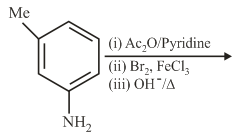
The reaction sequence involves treatment of an amide with $$Br_2$$ in an aqueous alkaline medium ($$KOH$$/$$NaOH$$). This combination is the classical Hofmann bromamide degradation (also called the Hofmann rearrangement).
Step 1 - Formation of N-bromoamide
The amide first undergoes base-catalysed deprotonation to give the anion, which is rapidly brominated by $$Br_2$$ to form an $$N$$-bromoamide.
Step 2 - Rearrangement to an isocyanate
On warming, the $$N$$-bromoamide loses $$Br^-$$. A concerted 1,2-migration (the “Hofmann rearrangement”) shifts the acyl $$R-CO-$$ group onto nitrogen, generating an isocyanate $$R-N=C=O$$ and releasing $$Br^-$$.
Step 3 - Hydrolysis of the isocyanate
Because the reaction medium is aqueous, the isocyanate is immediately attacked by water. Proton transfers followed by decarboxylation give a primary amine that contains one carbon fewer than the starting amide.
Thus an amide $$RCONH_2$$ is converted into the primary amine $$RNH_2$$.
Among the given options, Option D shows that primary amine. Hence the final major product is the amine obtained after Hofmann degradation.
Therefore, the correct choice is:
Option D which is: the corresponding primary amine ($$RNH_2$$)
Was this solution helpful?
Create a FREE account and get:
_1.webp)

Educational materials for JEE preparation

Ask our AI anything

AI can make mistakes. Please verify important information.
AI can make mistakes. Please verify important information.