Join Our JEE Preparation Group
Prep with like-minded aspirants; Get access to free daily tests and study material.
Sign in
Please select an account to continue using cracku.in
↓ →
Join Our JEE Preparation Group
Prep with like-minded aspirants; Get access to free daily tests and study material.
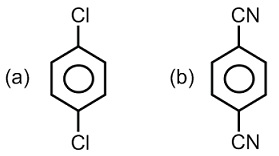
(a) p-dichlorobenzene: $$\mu = 0$$ because the single-atom $$\text{-Cl}$$ substituents align linearly along the para-axis and cancel each other completely.
(b) p-dicyanobenzene: $$\mu = 0$$ because the $$\text{-C}\equiv\text{N}$$ groups are strictly linear ($$sp$$-hybridized) and their opposite dipole vectors cancel out perfectly.
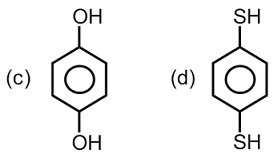
(c) p-dihydroxybenzene: $$\mu \neq 0$$ because the $$\text{-OH}$$ groups are bent ($$sp^3$$-hybridized), and their rotating conformations prevent perfect vector cancellation.
(d) p-dimercatobenzene: $$\mu \neq 0$$ because the $$\text{-SH}$$ groups are bent ($$sp^3$$-hybridized), resulting in a net structural dipole moment during rotation.
Was this solution helpful?
Create a FREE account and get:
_1.webp)

Educational materials for JEE preparation

Ask our AI anything

AI can make mistakes. Please verify important information.
AI can make mistakes. Please verify important information.