
Join Our JEE Preparation Group
Prep with like-minded aspirants; Get access to free daily tests and study material.
Sign in
Please select an account to continue using cracku.in
↓ →
Join Our JEE Preparation Group
Prep with like-minded aspirants; Get access to free daily tests and study material.
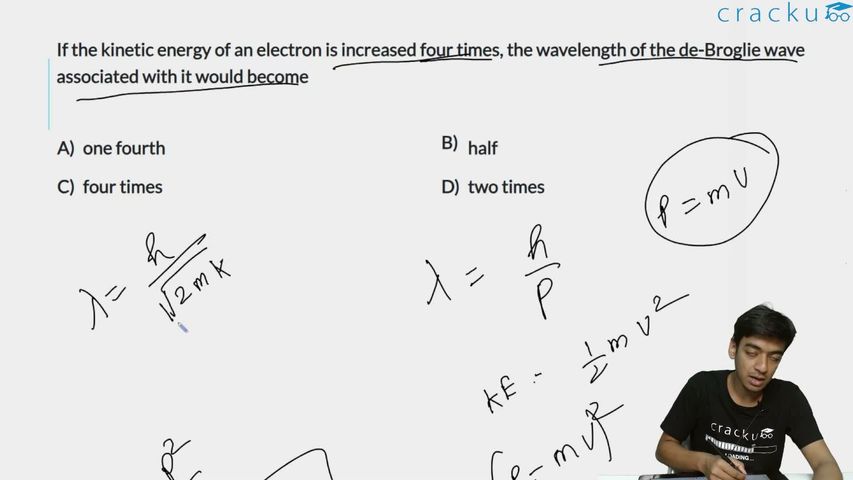
If the kinetic energy of an electron is increased four times, the wavelength of the de-Broglie wave associated with it would become
For any particle of mass $$m$$ moving with momentum $$p$$, the de-Broglie wavelength is
$$\lambda = \frac{h}{p}$$
For an electron whose speed is much less than the speed of light, the classical relation between kinetic energy $$K$$ and momentum $$p$$ is
$$K = \frac{p^{2}}{2m} \; \; \Longrightarrow \; \; p = \sqrt{2mK}$$
Substituting this $$p$$ in the de-Broglie formula,
$$\lambda = \frac{h}{\sqrt{2mK}}$$
Thus, the wavelength is inversely proportional to the square root of the kinetic energy:
$$\lambda \propto \frac{1}{\sqrt{K}}$$
If the kinetic energy is increased four times, i.e. $$K' = 4K$$, then
$$\lambda' = \frac{\lambda}{\sqrt{4}} = \frac{\lambda}{2}$$
Therefore, the de-Broglie wavelength becomes one-half of its original value.
Option B which is: half
Was this solution helpful?
Click on the Email ☝️ to Watch the Video Solution
Create a FREE account and get:
_1.webp)

Educational materials for JEE preparation

Ask our AI anything

AI can make mistakes. Please verify important information.
AI can make mistakes. Please verify important information.
