
Join Our JEE Preparation Group
Prep with like-minded aspirants; Get access to free daily tests and study material.
Sign in
Please select an account to continue using cracku.in
↓ →
Join Our JEE Preparation Group
Prep with like-minded aspirants; Get access to free daily tests and study material.
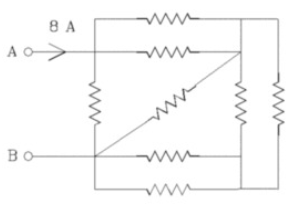
Find the current in the diagonal resistance. All resistances are equal.
Correct Answer: 2
Let each resistance be $$r$$ and call the right-hand top junction $$P$$ and the right-hand bottom junction $$Q$$. Between $$A$$ and $$P$$ there are two resistors in parallel ($$\frac{r}{2}$$), between $$B$$ and $$Q$$ also $$\frac{r}{2}$$, between $$P$$ and $$Q$$ two resistors in parallel ($$\frac{r}{2}$$), the diagonal connects $$P$$ to $$B$$ ($$r$$), and one resistor joins $$A$$ to $$B$$ directly ($$r$$). From $$P$$ to $$B$$ the diagonal $$r$$ is in parallel with the path $$P\text{-}Q\text{-}B$$ of $$\frac{r}{2} + \frac{r}{2} = r$$, giving $$\frac{r}{2}$$, so the branch $$A\text{-}P\text{-}B$$ has resistance $$r$$, equal to the direct resistor $$AB$$. Hence the 8 A splits into 4 A in each branch, and at $$P$$ the 4 A splits equally, so the diagonal carries 2 A.
Was this solution helpful?


Predict your JEE Main percentile, rank & performance in seconds

Educational materials for JEE preparation

Ask our AI anything

AI can make mistakes. Please verify important information.
AI can make mistakes. Please verify important information.