
Join Our JEE Preparation Group
Prep with like-minded aspirants; Get access to free daily tests and study material.
Sign in
Please select an account to continue using cracku.in
↓ →
Join Our JEE Preparation Group
Prep with like-minded aspirants; Get access to free daily tests and study material.
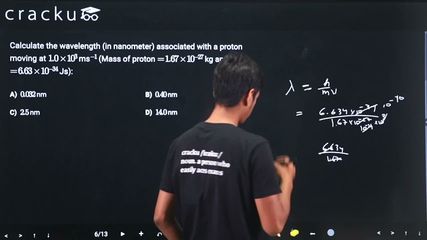
Calculate the wavelength (in nanometer) associated with a proton moving at $$1.0 \times 10^3$$ ms$$^{-1}$$ (Mass of proton $$= 1.67 \times 10^{-27}$$ kg and h $$= 6.63 \times 10^{-34}$$ Js):
For a moving particle, the de Broglie relation gives its wavelength: $$\lambda = \frac{h}{mv}$$ where
$$h$$ is Planck’s constant, $$m$$ is the particle’s mass and $$v$$ is its speed.
Substitute the given values:
$$h = 6.63 \times 10^{-34}\; \text{J s}$$,
$$m = 1.67 \times 10^{-27}\; \text{kg}$$,
$$v = 1.0 \times 10^{3}\; \text{m s}^{-1}$$
The momentum of the proton is
$$mv = \left(1.67 \times 10^{-27}\right)\left(1.0 \times 10^{3}\right)
= 1.67 \times 10^{-24}\; \text{kg m s}^{-1}$$
Hence the wavelength is
$$\lambda = \frac{6.63 \times 10^{-34}}{1.67 \times 10^{-24}}
= 3.97 \times 10^{-10}\; \text{m}$$
Convert metres to nanometres (1 nm = $$10^{-9}$$ m):
$$3.97 \times 10^{-10}\; \text{m}
= \frac{3.97 \times 10^{-10}}{10^{-9}}\; \text{nm}
= 0.397\; \text{nm} \approx 0.40\; \text{nm}$$
Therefore, the wavelength associated with the proton is $$0.40$$ nm.
Option B which is: $$0.40\;\text{nm}$$
Was this solution helpful?
Click on the Email ☝️ to Watch the Video Solution
Create a FREE account and get:
_1.webp)

Educational materials for JEE preparation

Ask our AI anything

AI can make mistakes. Please verify important information.
AI can make mistakes. Please verify important information.
