
Join Our JEE Preparation Group
Prep with like-minded aspirants; Get access to free daily tests and study material.
Sign in
Please select an account to continue using cracku.in
↓ →
Join Our JEE Preparation Group
Prep with like-minded aspirants; Get access to free daily tests and study material.
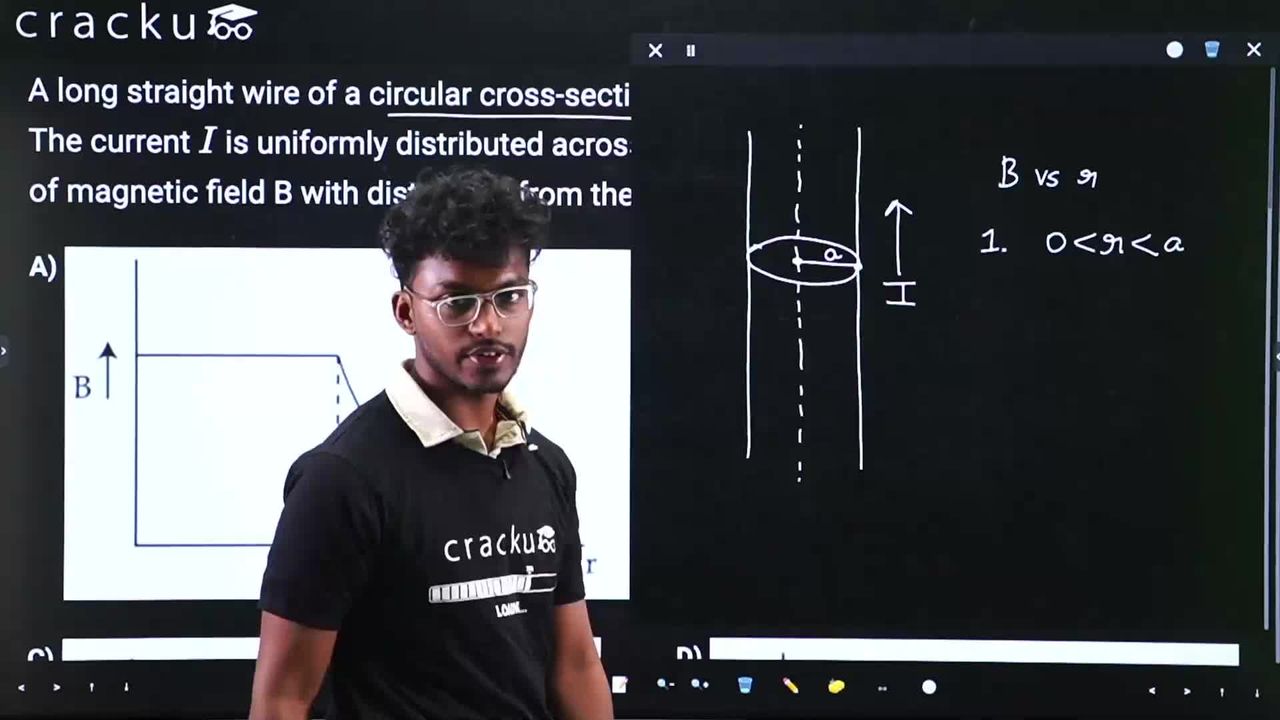
A long straight wire of a circular cross-section with radius '$$a$$' carries a steady current $$I$$. The current $$I$$ is uniformly distributed across this cross-section. The plot of magnitude of magnetic field B with distance $$r$$ from the centre of the wire is given by
To find the magnetic field $$B$$ at a distance $$r$$ from the center of the wire, we use Ampere's Circuital Law:
$$ \oint \vec{B} \cdot d\vec{l} = \mu_0 I_{enc} $$
Case 1: Inside the wire ($$r < a$$)
Since the current $$I$$ is uniformly distributed across the circular cross-section, the current enclosed ($$I_{enc}$$) by an Amperian loop of radius $$r$$ is proportional to the area:
$$ I_{enc} = I \left( \frac{\pi r^2}{\pi a^2} \right) = I \frac{r^2}{a^2} $$
Applying Ampere's Law:
$$ B (2\pi r) = \mu_0 \left( I \frac{r^2}{a^2} \right) $$
$$ B = \left( \frac{\mu_0 I}{2\pi a^2} \right) r $$
Therefore, inside the wire, the magnetic field increases linearly with distance: {$$B \propto r$$}.
Case 2: Outside the wire
For a point outside the wire, the Amperian loop encloses the entire current $$I$$:
$$ I_{enc} = I $$
Applying Ampere's Law:
$$ B (2\pi r) = \mu_0 I $$
$$ B = \frac{\mu_0 I}{2\pi r} $$
Therefore, outside the wire, the magnetic field decreases inversely with distance: {$$B \propto \frac{1}{r}$$}
Was this solution helpful?
Click on the Email ☝️ to Watch the Video Solution
Create a FREE account and get:
_1.webp)

Educational materials for JEE preparation

Ask our AI anything

AI can make mistakes. Please verify important information.
AI can make mistakes. Please verify important information.
