Sign in
Please select an account to continue using cracku.in
↓ →

Join Our JEE Preparation Group
Prep with like-minded aspirants; Get access to free daily tests and study material.
The vertices of a regular dodecagon (a polygon with $$12$$ sides) are coloured either blue or red. Let $$N$$ be the number of all possible colourings such that no three points of the same colour form the vertices of an equilateral triangle, and no four points of the same colour form the vertices of a square. If $$N$$ can be written as $$N=100p+q$$ where $$p,q$$ are two positive integers less than $$100$$, find $$p+q$$.
Correct Answer: 15
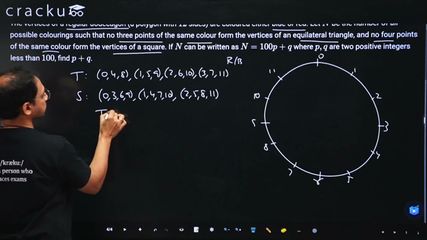
Label the vertices of the regular dodecagon $$0,1,2,\dots ,11$$ anticlockwise.
The three vertices of every equilateral triangle are obtained by jumping four steps, and the four vertices of every square are obtained by jumping three steps:
Equilateral triangles (step $$4$$):
$$\{0,4,8\},\; \{1,5,9\},\; \{2,6,10\},\; \{3,7,11\}$$
Squares (step $$3$$):
$$\{0,3,6,9\},\; \{1,4,7,10\},\; \{2,5,8,11\}$$
Introduce the $$4\times3$$ array whose rows correspond to the four triangles and whose columns correspond to the three squares:
$$ \begin{array}{ccc} 0 & 4 & 8\\ 9 & 1 & 5\\ 6 & 10 & 2\\ 3 & 7 & 11 \end{array} $$
Row $$r$$ consists of the vertices of triangle $$r$$ and column $$c$$ consists of the vertices of square $$c$$.
The conditions of the problem translate to
1. every row of the array is not monochromatic (avoids a monochromatic triangle);
2. every column of the array is not monochromatic (avoids a monochromatic square).
Count colourings row-wise first.
Step 1: impose the triangle condition (rows)
For one row of length $$3$$ there are $$2^3=8$$ possible colourings. Excluding the two monochromatic ones (BBB, RRR) leaves $$6$$ admissible patterns.
Because rows are independent at this stage,
$$|U| = 6^4 = 1296$$
colourings satisfy all the triangle conditions. Call this set $$U$$.
Step 2: exclude colourings that break at least one square condition (columns)
Let $$C_0,C_1,C_2$$ be the events “column $$0,1,2$$ is monochromatic”, respectively. We shall use the Principle of Inclusion-Exclusion inside the universe $$U$$.
• Single events. Fix column $$0$$ to be BBBB (the case RRRR is symmetric). In each row at least one of the remaining two entries must be red, so the allowed pairs are (BR, RB, RR) - three choices. Hence $$|C_0| = 2\cdot 3^4 = 162,$$ and similarly $$|C_1|=|C_2|=162$$.
• Intersections of two events. Suppose columns $$0,1$$ are monochromatic.
(i) If they carry the same colour (BB or RR), the third entry in every row is forced to be the opposite colour - exactly one choice per row. This gives $$2$$ colourings.
(ii) If the columns carry different colours (BR or RB), the third entry in a row may be B or R (two choices). This gives $$2\cdot2^4=32$$ colourings.
Thus
$$|C_0\cap C_1| = 2 + 32 = 34,$$
and by symmetry $$|C_0\cap C_2|=|C_1\cap C_2|=34$$.
• Intersection of three events. All three columns are monochromatic. There are $$2^3=8$$ colour triples; the two triples (BBB) and (RRR) violate the row condition, the remaining six comply. Hence $$|C_0\cap C_1\cap C_2| = 6.$$
Apply inclusion-exclusion:
$$ \begin{aligned} |C_0\cup C_1\cup C_2| &= \bigl(162+162+162\bigr) - \bigl(34+34+34\bigr) + 6\\ &= 486 - 102 + 6\\ &= 390. \end{aligned} $$
Step 3: final count
Colourings obeying both the triangle and square restrictions:
$$
N = |U| - |C_0\cup C_1\cup C_2| = 1296 - 390 = 906.
$$
Write $$N = 100p + q$$ with $$0\lt p,q\lt 100$$. Here $$N = 100\cdot 9 + 6$$, so $$p = 9$$ and $$q = 6$$.
Therefore, $$p + q = 9 + 6 = 15$$.
Answer: 15
Was this solution helpful?
Click on the Email ☝️ to Watch the Video Solution
Book Free CAT Mentorship
Get personalized CAT strategy from a 99%iler
500+ students mentored
OTP Verification
Enter the 6-digit code sent to your phone
Booking Summary
Enter OTP
Didn't receive the OTP?
_1.webp)

Predict your JEE Main percentile, rank & performance in seconds

Educational materials for JEE preparation

Ask our AI anything

AI can make mistakes. Please verify important information.
AI can make mistakes. Please verify important information.
 91- 6303239042

