
Join Our JEE Preparation Group
Prep with like-minded aspirants; Get access to free daily tests and study material.
Sign in
Please select an account to continue using cracku.in
↓ →
Join Our JEE Preparation Group
Prep with like-minded aspirants; Get access to free daily tests and study material.
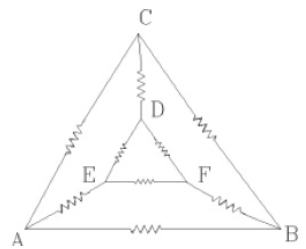
All resistances shown in the figure are equal. Equivalent resistance between $$A$$ and $$B$$ when resistance between $$C$$ and $$D$$ is removed is $$R$$. The removed resistance is reconnected and the resistances between the corners $$B, C$$ and $$D, E$$ are now removed. What is the equivalent resistance between $$A$$ and $$B$$ now.
Correct Answer: 0
Let each resistance be $$r$$, and put $$A$$ at potential 1 and $$B$$ at 0. With $$CD$$ removed, by symmetry $$C$$ and $$D$$ are at $$\frac{1}{2}$$, and Kirchhoff's law at $$E$$ gives $$E$$ at $$\frac{5}{8}$$ and $$F$$ at $$\frac{3}{8}$$. The current from $$A$$ is $$1 + \frac{1}{2} + \frac{3}{8} = \frac{15}{8}$$, so $$R = \frac{8r}{15}$$. In the second case the network is $$AB$$ in parallel with [($$A\text{-}C\text{-}D\text{-}F$$, $$3r$$) parallel to ($$A\text{-}E\text{-}F$$, $$2r$$), then $$FB$$], i.e. $$r$$ in parallel with $$\frac{6r}{5} + r = \frac{11r}{5}$$, giving $$\frac{11r}{16}$$. Hence the new resistance is $$\frac{11r}{16} = \frac{11}{16} \times \frac{15R}{8} = \frac{165R}{128} \approx 1.29R$$.
Was this solution helpful?


Predict your JEE Main percentile, rank & performance in seconds

Educational materials for JEE preparation

Ask our AI anything

AI can make mistakes. Please verify important information.
AI can make mistakes. Please verify important information.