
Join Our JEE Preparation Group
Prep with like-minded aspirants; Get access to free daily tests and study material.
Sign in
Please select an account to continue using cracku.in
↓ →
Join Our JEE Preparation Group
Prep with like-minded aspirants; Get access to free daily tests and study material.
Which of the plots shown in the figure represents speed ($$v$$) of the electron in a hydrogen atom as a function of the principal quantum number ($$n$$)?
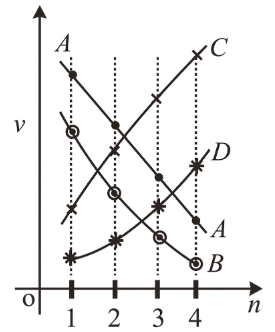
The Bohr model gives two key relations for an electron revolving in the $$n^{\text{th}}$$ orbit of a hydrogen atom:
1. Angular‐momentum quantisation:$$m v_n r_n = n\hbar\qquad -(1)$$
2. Centripetal force equals Coulombic attraction:$$\frac{m v_n^{2}}{r_n} = \frac{e^{2}}{4\pi\epsilon_0 r_n^{2}}\qquad -(2)$$
From $$-(2)$$ we get $$m v_n^{2} r_n = \frac{e^{2}}{4\pi\epsilon_0}\qquad -(3)$$
Divide $$-(3)$$ by $$-(1)$$ to eliminate $$r_n$$:
$$\frac{m v_n^{2} r_n}{m v_n r_n} = \frac{\dfrac{e^{2}}{4\pi\epsilon_0}}{n\hbar}$$
$$\Rightarrow v_n = \frac{e^{2}}{4\pi\epsilon_0\hbar}\,\frac{1}{n}\qquad -(4)$$
Equation $$-(4)$$ shows that the speed $$v_n$$ is inversely proportional to the principal quantum number $$n$$:
$$v_n \propto \frac{1}{n}$$
Thus, when $$n$$ increases (electron jumps to higher orbits), its speed decreases hyperbolically. Among the four sketches given in the question, the only curve that falls as $$1/n$$ is the plot labelled “B”.
Therefore, the correct representation is:
Option A which is: $$B$$
Was this solution helpful?
Click on the Email ☝️ to Watch the Video Solution
Create a FREE account and get:
_1.webp)

Educational materials for JEE preparation

Ask our AI anything

AI can make mistakes. Please verify important information.
AI can make mistakes. Please verify important information.


