
Join Our JEE Preparation Group
Prep with like-minded aspirants; Get access to free daily tests and study material.
Sign in
Please select an account to continue using cracku.in
↓ →
Join Our JEE Preparation Group
Prep with like-minded aspirants; Get access to free daily tests and study material.
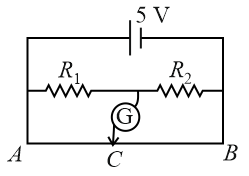
In the given figure of meter bridge experiment, the balancing length AC corresponding to null deflection of the galvanometer is 40 cm. The balancing length, if the radius of the wire AB is doubled, will be _____ cm.
Correct Answer: 40
We need to determine the new balancing length in a meter bridge experiment when the radius of the wire $$AB$$ is doubled.
A meter bridge operates on the principle of a balanced Wheatstone bridge. When the galvanometer shows null deflection (zero current), the ratio of the resistances in the two parallel arms is equal:
$$\frac{R_1}{R_2} = \frac{R_{AC}}{R_{CB}}$$
Where:
The resistance of a uniform wire of length $$l$$, resistivity $$\rho$$, and cross-sectional area $$A$$ is given by:
$$R = \rho \frac{l}{A}$$
For the two segments of the same uniform wire:
Substituting these into the balancing condition:
$$\frac{R_1}{R_2} = \frac{\rho \frac{l_1}{A}}{\rho \frac{(100 - l_1)}{A}} = \frac{l_1}{100 - l_1}$$
Notice that the resistivity ($$\rho$$) and the cross-sectional area ($$A$$) cancel out completely from the ratio. The balancing length depends only on the ratio of the resistances $$R_1$$ and $$R_2$$, and the total length of the wire.
When the radius of the wire $$AB$$ is doubled, the cross-sectional area ($$A = \pi r^2$$) increases uniformly across its entire length.
Since the area changes identically for both segments ($$AC$$ and $$CB$$), it still cancels out in the balance equation. As long as the resistors $$R_1$$ and $$R_2$$ remain unchanged, the balancing length $$l_1$$ remains exactly the same.
Since the balancing length is independent of the thickness or radius of the uniform bridge wire, it will remain unchanged.
The balancing length will be 40 cm.
Was this solution helpful?
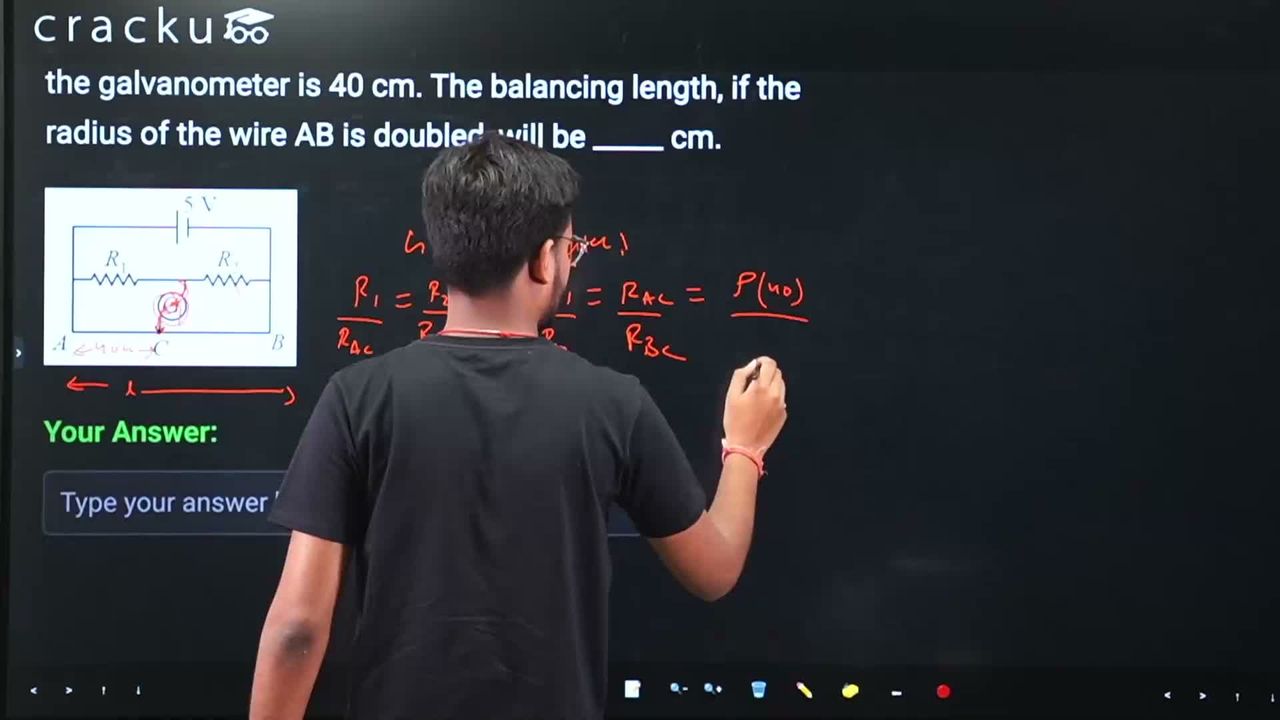
Click on the Email ☝️ to Watch the Video Solution
Create a FREE account and get:
_1.webp)

Educational materials for JEE preparation

Ask our AI anything

AI can make mistakes. Please verify important information.
AI can make mistakes. Please verify important information.
