
Join Our JEE Preparation Group
Prep with like-minded aspirants; Get access to free daily tests and study material.
Sign in
Please select an account to continue using cracku.in
↓ →
Join Our JEE Preparation Group
Prep with like-minded aspirants; Get access to free daily tests and study material.
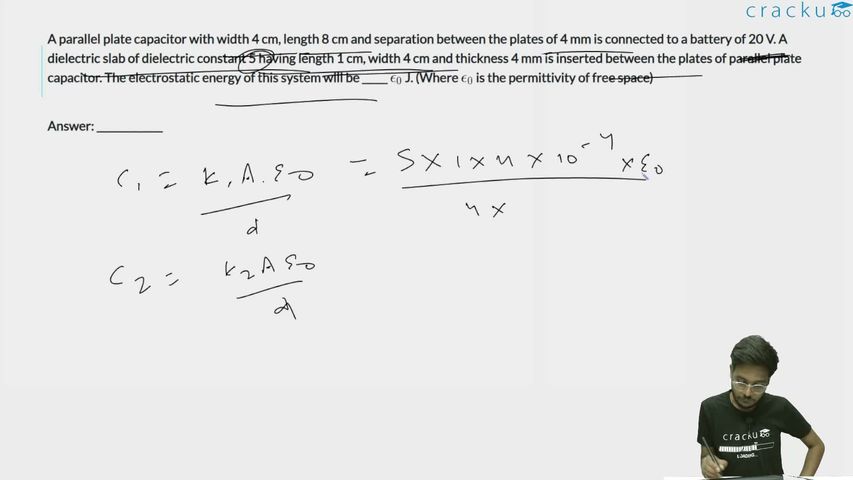
A parallel plate capacitor with width 4 cm, length 8 cm and separation between the plates of 4 mm is connected to a battery of 20 V. A dielectric slab of dielectric constant 5 having length 1 cm, width 4 cm and thickness 4 mm is inserted between the plates of parallel plate capacitor. The electrostatic energy of this system will be _____ $$\epsilon_0$$ J. (Where $$\epsilon_0$$ is the permittivity of free space)
Correct Answer: 240
We are given a parallel plate capacitor with width = 4 cm = 0.04 m, length = 8 cm = 0.08 m, and separation = 4 mm = 0.004 m, connected to a battery of voltage V = 20 V.
A dielectric slab of dielectric constant $$\kappa = 5$$, length = 1 cm, width = 4 cm, and thickness = 4 mm is inserted into the capacitor.
Since the dielectric slab occupies the same width and thickness as the capacitor but spans only 1 cm of the total 8 cm length, the system can be modeled as two capacitors in parallel: one region containing the dielectric of length 1 cm = 0.01 m (denoted $$C_1$$) and another region without the dielectric of length 7 cm = 0.07 m (denoted $$C_2$$).
Substituting into the standard expression for a parallel‐plate capacitor, we find
$$C_1 = \frac{\kappa \epsilon_0 \times \text{width} \times \text{length}_1}{\text{separation}} = \frac{5\epsilon_0 \times 0.04 \times 0.01}{0.004} = \frac{5\epsilon_0 \times 4 \times 10^{-4}}{4 \times 10^{-3}} = 0.5\epsilon_0$$
and
$$C_2 = \frac{\epsilon_0 \times \text{width} \times \text{length}_2}{\text{separation}} = \frac{\epsilon_0 \times 0.04 \times 0.07}{0.004} = \frac{\epsilon_0 \times 28 \times 10^{-4}}{4 \times 10^{-3}} = 0.7\epsilon_0$$
Therefore, the total capacitance is $$C = C_1 + C_2 = 0.5\epsilon_0 + 0.7\epsilon_0 = 1.2\epsilon_0\,.$$
From this capacitance and the applied voltage, the electrostatic energy stored is $$U = \tfrac{1}{2} C V^2 = \tfrac{1}{2} \times 1.2\epsilon_0 \times (20)^2 = \tfrac{1}{2} \times 1.2\epsilon_0 \times 400 = 240\epsilon_0 \text{ J}\,.$$
Thus, the answer is 240.
Was this solution helpful?
Click on the Email ☝️ to Watch the Video Solution
Create a FREE account and get:
_1.webp)

Educational materials for JEE preparation

Ask our AI anything

AI can make mistakes. Please verify important information.
AI can make mistakes. Please verify important information.
