
Join Our JEE Preparation Group
Prep with like-minded aspirants; Get access to free daily tests and study material.
Sign in
Please select an account to continue using cracku.in
↓ →
Join Our JEE Preparation Group
Prep with like-minded aspirants; Get access to free daily tests and study material.
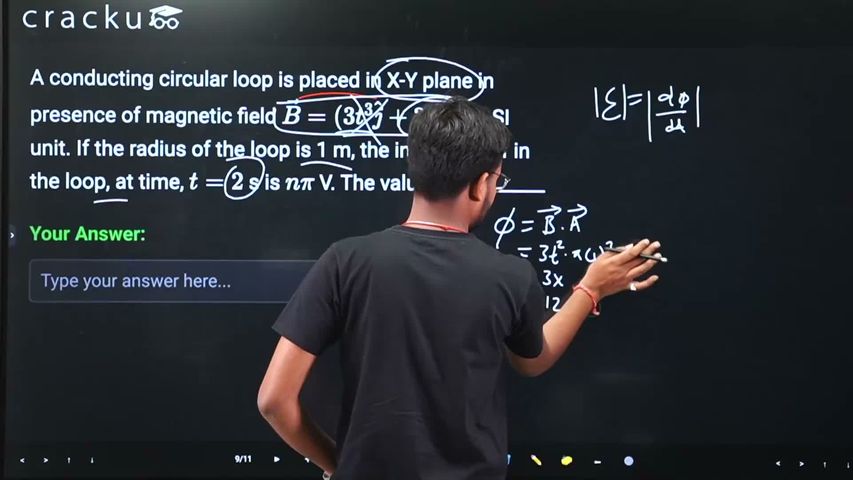
A conducting circular loop is placed in X-Y plane in presence of magnetic field $$\vec{B} = (3t^3\hat{j} + 3t^2\hat{k})$$ in SI unit. If the radius of the loop is 1 m, the induced emf in the loop, at time, $$t = 2$$ s is $$n\pi$$ V. The value of $$n$$ is _____
Correct Answer: 12
We are given a conducting circular loop of radius $$r = 1$$ m placed in the X-Y plane, and the magnetic field is:
$$\vec{B} = 3t^3\hat{j} + 3t^2\hat{k}$$
Since the circular loop lies in the X-Y plane, its area vector is along the $$\hat{k}$$ direction (perpendicular to the X-Y plane), only the $$\hat{k}$$ component of $$\vec{B}$$ contributes to the magnetic flux through the loop because the $$\hat{j}$$ component is parallel to the plane and does not contribute.
Substituting this into the definition of magnetic flux gives
$$\Phi = \vec{B} \cdot \vec{A} = (3t^2) \times (\pi r^2) = 3t^2 \times \pi \times (1)^2 = 3\pi t^2$$
From the above flux expression, using Faraday’s law, the magnitude of the induced EMF is
$$|\mathcal{E}| = \left|\frac{d\Phi}{dt}\right| = \frac{d}{dt}(3\pi t^2) = 6\pi t$$
Evaluating this expression at $$t = 2\text{ s}$$ gives
$$|\mathcal{E}| = 6\pi \times 2 = 12\pi \text{ V}$$
Since the induced EMF is $$n\pi$$ V, we have
$$n = 12$$
The answer is 12.
Was this solution helpful?
Click on the Email ☝️ to Watch the Video Solution
Create a FREE account and get:
_1.webp)

Educational materials for JEE preparation

Ask our AI anything

AI can make mistakes. Please verify important information.
AI can make mistakes. Please verify important information.
