
Join Our JEE Preparation Group
Prep with like-minded aspirants; Get access to free daily tests and study material.
Sign in
Please select an account to continue using cracku.in
↓ →
Join Our JEE Preparation Group
Prep with like-minded aspirants; Get access to free daily tests and study material.
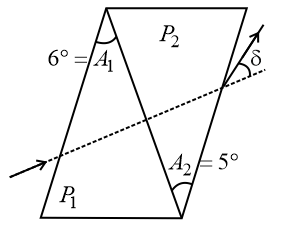
A thin prism of angle $$6^\circ$$ and refractive index for yellow light $$(n_Y) = 1.5$$ is combined with another prism of angle $$5^\circ$$ and $$n_Y = 1.55$$. The combination produces no dispersion. The net average deviation $$\delta$$ produced by the combination is $$\left(\frac{1}{x}\right)^\circ$$. The value of $$x$$ is _____
Correct Answer: 4
We need to determine the value of $$x$$ given that the net average deviation produced by a combination of two thin prisms is equal to $$\left(\frac{1}{x}\right)^\circ$$.
The average (or net) deviation ($\delta$) produced by a single thin prism for mean (yellow) light is given by the formula:
$$\delta = (n - 1)A$$
In this non-dispersive setup, the two prisms are placed inverted relative to each other (as shown in the diagram), meaning their individual deviations oppose one another. The net average deviation ($$\delta_{\text{net}}$$) is the difference between their individual deviations:
$$\delta_{\text{net}} = \delta_1 - \delta_2$$
First, let's find the deviation produced by the first prism ($$\delta_1$$):
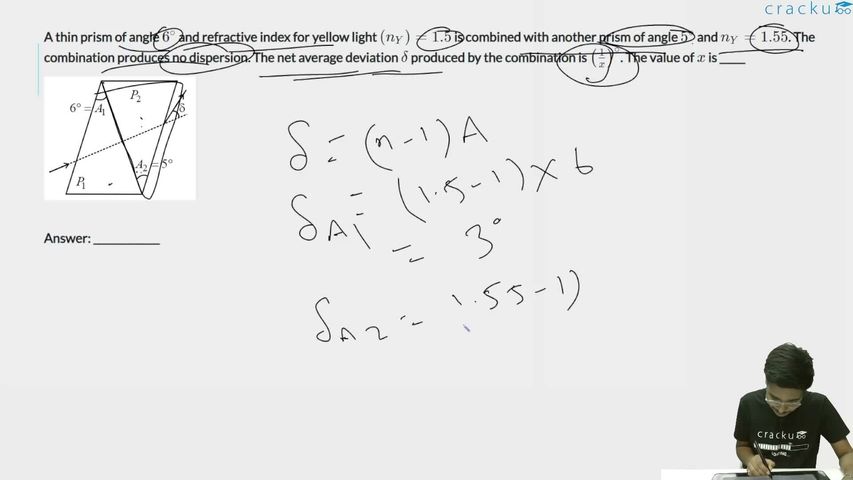
$$\delta_1 = (1.5 - 1) \times 6^\circ = 0.5 \times 6^\circ = 3^\circ$$
Next, let's find the deviation produced by the second prism ($$\delta_2$$):
$$\delta_2 = (1.55 - 1) \times 5^\circ = 0.55 \times 5^\circ = 2.75^\circ$$
Subtracting the two values gives the total net deviation of the combination:
$$\delta_{\text{net}} = 3^\circ - 2.75^\circ = 0.25^\circ$$
We can convert this decimal value into a fractional form to match the format given in the problem statement:
$$\delta_{\text{net}} = \left(\frac{25}{100}\right)^\circ = \left(\frac{1}{4}\right)^\circ$$
Comparing this result with the expression $$\left(\frac{1}{x}\right)^\circ$$
$$\frac{1}{x} = \frac{1}{4} \implies x = 4$$
The value of $$x$$ is 4.
Was this solution helpful?
Click on the Email ☝️ to Watch the Video Solution
Create a FREE account and get:
_1.webp)

Educational materials for JEE preparation

Ask our AI anything

AI can make mistakes. Please verify important information.
AI can make mistakes. Please verify important information.
